Merging with the Wild Beyond
Life Dimensions #9: Through the Fence and Into the Web

Returning yet again to explore this embodied spiritual trajectory, leading from exploring inside who I am, to becoming at last part of the great We Web. You can find the previous meditations in this series here. Over on the podcast, the latest episode, ‘More Tales From Albion’, will catch you up with my travels through Western Europe in an audio version of the last two articles. More of those coming soon!
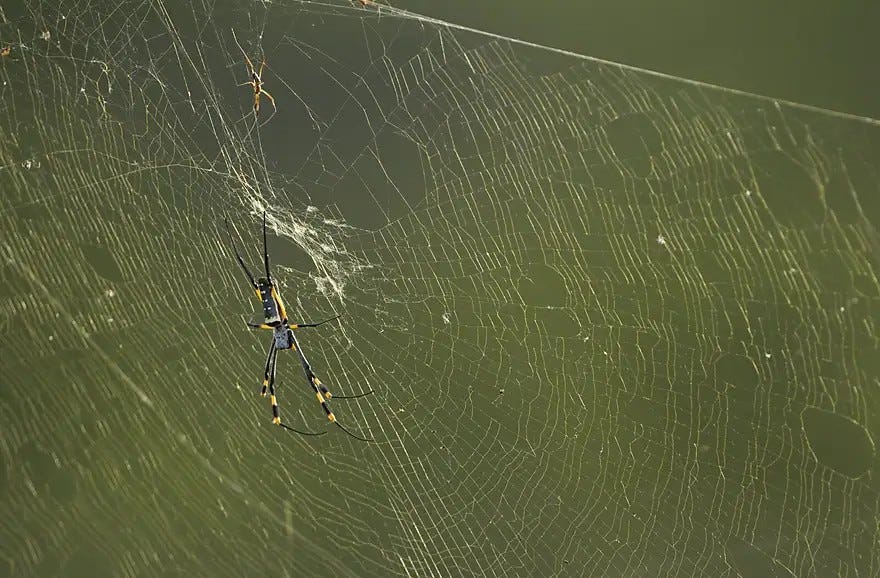
Shamanically, spiders are seen as representations of the creative goddess. Sure, she bites off the odd egotistical head or two, like Kali, and parts of us are almost as terrified as Tolkien clearly was of getting stuck forever in her gluey webs, but the masterly ongoing invention in her mandalas is obvious in the morning light, crossing the forest paths that no big creature has crashed through since last night. She dances with creation and destruction of course, and the spider’s prey is wrapped up in a very visual play of the constant decay of things that’s also necessary for creation. That we are part of this organic world, though, is not immediately obvious to urban-dwelling moderns, trying to fight off collapse the whole time from within our gated complexes, worried that the wildness will drive us into madness.
When I was a kid I loved building stuff, creating worlds with Lego or Meccano. When ‘home computers’ started being a thing, with my love of numbers, I enjoyed the way a 1980s BASIC computer program could emerge; how down at the coding level, individualised bits became absorbed into 8-bit bytes that would eventually become gigantic structures called kilobytes, containing 1024 of these bytes: 1024 because that’s a power of 2, and computer circuit boards are based around binary possibilities, as seen in any flow chart. From 0s and 1s the stable silicon world comes into being. And brick walls, with their similar units, each one a functional part of the whole without much to say personally. We kind of want our bricks to remain solid, stable, unchanging whatever the weather. We wonderful ‘look at me!’ humans, however, come in with a different kind of spark, seen in any toddler.
So when we reach out to others and beyond our very personal parish territory, it’s partly with a trepidation that we’ll get squashed Kafka-like into the System. Most of our dystopian visions involve us becoming mechanical cogs in a totalitarian script where individual freedom is reduced to what’s ‘safe’ for all, and in the interests of the whole, as dictated perhaps by the queen bee. And of course our ancestral communist dreams didn’t work out so well in practice. The missing piece, in my eyes, is the love-glue of connection we can call spirit. There’s an optimal size of human community, and it’s a lot smaller than the number of bytes in a Kb or bees in a hive. Around 150 is Dunbar’s number - where our brains and hearts can still have a real existential relationship with the other members of the tribe that is tangible, not just a number of fleeting followers and likes, or a half-remembered photo. By animal and insect standards, that’s not terribly large. A big high school grade might have this many kids or more; perhaps no wonder that I hardly recall anyone from school that wasn’t actually in my year.
This is important because it turns out that carbon-based relating actually wants each part to be dynamic, not just functional like a brick. No disrespect to baked clay, which has lots to teach us, but we didn’t incarnate to become bricks, surely. We come to be a creative loving dynamo of some kind; imaginative system designers understand this. (That’s probably what all that hilariously-labelled ‘junk DNA’ is about, as labelled by overly-simplifying researchers working on desktop computers: it’s actually potent potential interacting with its environment). We’ve had plenty of unimaginative Fat Controllers at the self-appointed ‘top end’ there, trying to use us as Lego; and perhaps some of them are currently training AI models to do the same as the next era of factory fodder planning emerges. Grand company-scale dystopias exist already (and the big picture of the corporation was long ago analysed as an essentially psychopathic being); just as there are grand bureaucratic entities acting in the same way. Whereas an aspect of our human dynamism, by contrast, is this quest we have to stand out, to win against the rest, to see the competitive Darwinian paradigm out there as our personal challenge to become Superman.
Oops. That’s nonsense in the bigger picture of things, as we spin around our beautiful blue-green rock in space. Yet it’s a potent, arrogant drive, from somewhere in us, that somehow we have to tame again in order to function as part of a refreshed System of Many. By contrast, within us too is this desire to fit in. Either we’re weird and potentially separate enough to become megalomaniac, or we’re boring squares bringing nothing novel to life. The former tends towards that pole of evil that Steiner called Luciferic – the fallen angel; the latter towards the Satanic/Ahrimanic, which our mechanical society is highlighting, removing our current generations from organic relationship and into boxes. Somewhere between the two operates the compassionate individual aware of their community, of their surroundings. And it’s from this plane that we can find and teach the flowing balance needed to be part of a really dynamic living system. Silicon, incidentally, has the same capacity for 4 covalent electrons as carbon, but is too heavy to build organic life, and it struggles with water as much as my old cellphone in the cistern. So it's a strangely “dead” contrast to carbon, on which our modern tech is creating this unsatisfactory ‘metaverse’. It also shows up in crystals and sand across the planet, upon which new forms can be crafted, sometimes just to be blown away in a day. There’s much more to this elemental planetary story to be uncovered, if we start listening more to what’s actually around us.
Real experiential learning depends on our awareness of the flowing dynamics of the world beyond us as much as within us. The birds chattering in my garden, while bees buzz over the red succulent flowers today; these are in a system with wonderfully differentiated parts. The wind blows the palm leaves of the fat strelitzia, its flowers looking like the birds and hinting at other connections. Fruits are plumping up on the granadilla vine that a few weeks ago was budding into flower. Those passion fruit flowers, in fact, are remarkably complex systems themselves, and the energy they absorb is transported towards these ripening fruit. These parts are all playing their role in a natural web of life, and systems thinkers like Fritjof Capra have been talking about this for decades. Indigenous knowledge has held these connections up to the light for much longer though. Currently I’m looking at the Doctrine of Signature, in Julia Graves’ book, “The Language of Plants”, where she draws on wisdom from multiple world traditions. Observing how this system functions requires a lot more engagement of the right hemisphere of the brain than mere categorizing and counting. Plants give us hints of the broader connections, the archetypal meanings and medicines they bring, behind their personal growth dynamics; their shapes, textures, scents, colours, the relative strength of their constituent parts. All these help with identifying their individual characteristics. Then we can tune in better to their intentions, and which parts of our inner worlds, our overall system, they might best support, at which stage in their own growth cycle.
In fact, as ecologists and systems thinkers have long declared, these dynamic parts are one of the drivers of making a mere ‘system’ into a greater organism, with different nodes of intelligence, of obtaining sensory information, of acting on it. Thus the biome becomes a being. That’s where the notion of ‘as within so without’ begins to play with us. Plenty of mystics have told us we’re merely drops in the ocean, and that’s perhaps not much more inspiring than being a brick in a wall. The ocean’s a great thing, but what about me! However, we’re probably not seeing water like we could. From a three-dimensional material perspective, water is a clear liquid that doesn’t appear to be broken up into differentiated sections and beings. From a traditional elemental perspective, it’s actually full of beings – undines, nymphs, whatever – operating in ways we can’t easily differentiate, but that doesn’t mean different bodies of water don’t have different personalities and characteristics. On a grand scale, the ocean becomes a mighty god; but this goddess has within her infinities of smaller and chattier characters. And at the same time, the ocean echoes to us our own mother's womb (or vice versa), with which it has a similar proportion of salts. No wonder our story goes that life began there. And then water interacts, with the help of algae and fungus and other more mysteriously invisible beings, towards clouds and rain drops and the churning forces of life. Oh, and clay, which plenty of religions say, actually, we are made from, including modern evolutionary biology. Clay is surprisingly alive, as many a potter would declare as they propitiate the kiln elf. Maybe I wouldn’t mind being a certain kind of brick for a while after all.
We humans, then, are here to tell the story of the cycles, of the interactions. Many mythical cycles would concur (and the most famous of course, the Odyssey, is about a journey across the salt waters). Epics are narratives of the many and the connections between them – the third ancient Greek category of creative speech, beyond the personal reflections of the lyric and the interplay of the dramatic, into an often lengthy appreciation for the dynamic whole. Some of them aim at the illusion of objectivity, a Homer describing it all authoritatively in a way that would lead into multiple examples of modern novels. Others are a little more honest about the way the storytellers are themselves at the mercy of, or bringing agency to, the events they’re describing. Vyasa it is who tells the longest of all epics, the Mahabharata, yet he also turns up in the story himself; and Scheherezade tells her tales of the 1001 nights for her own famous reasons. The Arabian night tales themselves were localised versions of others that appear in, for example, Somadeva’s Kathāsaritsāgara, a long compendium told to Shiva himself, that god of creative fire. Full of stories that frame other stories, where suddenly the person you thought was a lead character starts themselves telling another story entirely. Indian culture has seemingly relished this form of writing, which dismantles any attempts at historical objectivity before it can get too much of a limiting foothold. No doubt a culture that has had around it vibrant tropical rainforests to draw inspiration from will tend to be inclined in this kind of direction, with multiple strands of creativity occurring. More recently Western writers have also taken on this kind of awareness a little more; Max Sebald’s Austerlitz is a series of true tales within a frame, and written continously, without the paragraph break I’m about to make: the tale goes on connecting in new and surprising ways, as it should when we want to reach beyond the permanent solutions of fascist regimes with their One True Story.
Language itself is perhaps the supreme human ‘system’, ever-evolving even as we attempt to define it and argue for what makes it correct. And in its creative adaptability, it is both beautiful and something we should be rather humble about. One exercise I’ve done with students is around the kinds of words different sounds give rise to. Drip drag drown drink drug; a certain fluid heaviness. Glint glamour glide glory glitter; light, air, sparkle, perhaps more superficial. Crack crumple crunch crisis crater: breaking with force (and creativity itself of course! Big bangs). Where did these sounds come from? Are they qualities of the organic world we’re part of, or more accurately that our ancestors were part of, reflected in the way we pronounce things with our magical human vocal chords? There is an interconnectedness we can relax into here, where each word is special, each sentence unique, and the story emerges in its recognisable wholeness that doesn’t diminish the value of each player. And if we’re back at Story, which I discussed in an earlier episode in this series, we must acknowledge that one different piece we’re connected to is ourselves in the past, or the actions taken by our ancestors, or the ones we’re taking that will lead in a thread to our descendants. So even as we venture out, flowering beyond our own previous limits, we’ll find ourselves vibing with seeds and fruits from other flowering times. Maybe if we start remembering that silicon is all about crystal, we’ll find a little more cosmic mineral magic in the new language that pulses up from these keyboards and screens.
Shiva is a particularly potent image for the journey beyond the barrier, because as the destroyer he represents a vital force, the one that humbles us. All this will pass. It’s very much part of the organic system too. Organic obsolescence, however, does not happen in the way that ruthless capitalist designers build in to their mechanical products. (Long attested, in documentaries like The Light Bulb Conspiracy, and now manifestly obvious in all those greedy unnecessary upgrades we're subjected to). There’s a natural pacing by which those parts of the system that are there to destroy, to transform, be they fungus or fly, operate slowly and finally swing the balance, often very quickly, towards reinvention. Until recently the value of the hidden mycelial networks was itself a hugely humble thing, unrecognised by humans looking (as we do) for the stars of the forest show. Yet it’s almost become a cliché now to talk about these fibrous links, this great and tangled web, upon which the complexity and diversity of life depends. When watching mushrooms years ago I wondered about their relationships, how they might refer to each other. Yet of course mushrooms are only briefly individuals before the network takes them back and converts them once more. Our particular lives aren’t much longer when measured against geology, but our continuing existence is guaranteed, just like theirs.
There’s a whole lot of mystery to the interconnectedness, which the part of my personality that really wants to ‘figure things out’ is curious about. Yesterday I saw a friend I hadn’t seen for years early in the day. Then hours later we bumped into each other again, in a completely different part of the city, in a forest with nobody else around. Synchronicity is the part of the story where we get to also be authors, be Scheherezades with agency, even in the thick of the many. And to wonder. To wonder what actually lies over the edge of the waterfall. To follow the journey by taking the left-hand path we’ve never chosen before. GPS will not help us to get out of the box, and so it’s a question of breathing, trusting, once more being awake as we cross out of our familiar demarcated spaces. I look down at the ground less on walks than I used to, surer of my footfalls, more present to the unfolding drama around me, to the conversations going on between breeze and pine, light and green. Not necessarily because I need to ‘figure out what’s going on’ but because seeing the stage I’m acting upon, and acknowledging more of it, is part of helping me to fit into it.
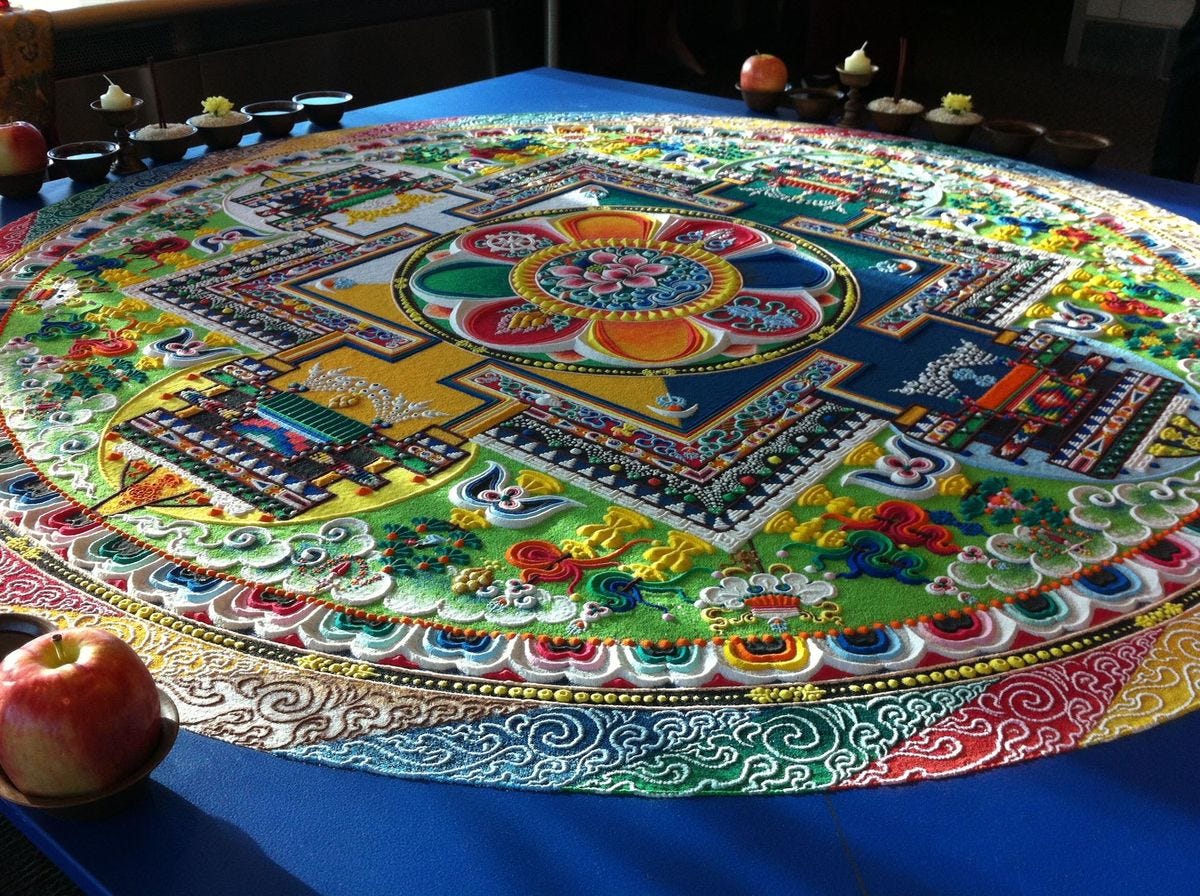
She’s been waiting for us to do that for a while, of course. Artistic mandalas have a geometric appreciation of the cycles of the world, though they can last on also until they become mystery. Music was more ephemeral until recording technology started preserving it. It is one of our key ways in to matching and being part of the zeitgeist rhythms of the world. There was expressed music before there was speech, and it made us want to dance. Each note is part of a temporal melodic line; and it can be part of a group harmony too. Playing and singing music is where I’ve felt the connections grown viscerally thicker, as we’ve come into alignment with the bigger song. Sometimes with the prop of sheet music, because that’s a great way to learn to trust that your part is worthy. Sometimes dropping away from that into listening and finding the subtle addition, the one that doesn’t dominate or distract, but adds a new level. There are symphonies in the forests and the deserts and the oceans, operating in multiple sensory octaves, and we can have a part there too, even if we’re often the toddlers looking for recognition (certainly most of our current political and economic leaders would fall into this category. A fascinating stage of evolution for our young species). Many cultures see human chants and sacred songs as engine oil for the planet and the cosmos.
Yet there’s also always the dynamism at play, once we enter the realm of many, and we really don’t have a monopoly on it. Whale songs change dynamically from time to time, when one whale catches a whiff of a different melody and teaches the new hit single to the rest. There are patterns to this dance of connectivity that we can learn to observe better, so that we can sense the next direction for the mandala. Our highly individualist modern cultures have given rise to particular artistic forms that reflect our personal psychological battles, but now it’s surely time to remember that our navels are just the endpoints of invisible umbilical cords to the greater movement. Ironically the development of AI slop may force our hands with this. Slop is exactly what we don’t want. Slip slide slither sludge slowing... well maybe slowing down is what we want. How do we get creative when the machine wants to imitate it all? This will require us to slow down from the hundredth ‘creative’ post of the day. Obviously we slow down best by doing our creativity in person. Performance in the moment, after practise, tuning in, respecting the other beings we’re performing with, be it nylon string or magic wand or undefinable quality of the moment. Where the connection, the embodied connection can be felt, by the crowd of 150 or so if we’re lucky, and the fire can be stoked; the fire that also extinguishes our artistic egos each time we create something again.
It’s co-creation in the end. I had a wild night once where I decided not to be in charge but to ask anyone I met what should happen next, and to go with it. The enormous relief of not having to bear all of this alone is quite essential in these times. Our tiny minds can’t figure it all out, even as we might be designed to try. And so where there may have been victory in our marking of our frontiers, here there is instead the joy of surrender. It’s not always comfortable. Sit still for too long in the forest and something will nibble you. Our ancestors co-created prayer for such times, which is another kind of chant. Our egos want us to get spiritual support for our personal success. Our wiser selves chant for the good of the universe because it’s something we’re designed to do. Somewhere between the two, the next chapter begins. To get there we have to open the door, take off the protective coat, make a suggestion or a response, and keep feeling where to put our feet next to remain untrapped on the tightrope-formed web. On which note, I’ve written enough for today. Time to head off and see which part of the play - the great lila of life as the ancients would have it - wants to be performed next.