Finding Edges
Life Dimensions #8: Venturing Out

Having ventured “in” on this embodied spiritual journey, we now invert the direction once more and head towards the circumference. You can find all the previous explorations of Life Dimensions here as well as in audio versions on the podcast. The latest podcast episode, however, captures the most recent two installments of my Western European adventures, to which I will soon return here too.
Scabbards are important. Without them a sword does random damage and gets blunted more quickly. We have sheaths around us too: beginning of course with the skin, that very physical manifestation of Edgeness. A marker of crossing from in to out, accompanied by other sense organs that can track the external. It has its own micro boundaries, beyond the epidermis, say. And, crucially, it’s also porous. This is the paradoxical nature of borderlands, if we’re not to become hermetically, dangerously sealed up.
Sealing is its own process. Royal seals which prevent breakage through the power that stands behind the wax. The colossal numbers of locks on chests to control colonial secrets, or perhaps gold and silver, until today’s more illusory but impermeable seals come along. Blockchain titanium numbers. Or the ultra-tech raincoats sailors use to keep storms out. Over aeons, of course, the outside will get through; imperialists will raid our sacred tombs; the wind and rain will epoch-carve through granite. And we do want the world to trickle through, but we also want a good filtering system, as we stretch out to express ourselves safely in the world. A layer of protection, even if they’re just silk gloves. An airlock like in the movies. Or like the membrane we once got used to that lined the womb.
A garden fence through which the world can be seen is better than a concrete wall that doesn’t let you see the plotting intruders. But both are markers of humans claiming territory; while birds soar over, snails slip through, and nocturnal mammals still cross. Unless the attack dogs go for them instead. There’s something very military about these external borders we make: brittle brutality to keep up the pretence. My own ancestors lived in the badlands between the realms of Scotland and England, where the border was a fine line on paper but worthless in practice until the nations collided. Walls have done their best to keep people separated; be it the peace lines between Shankill and Falls Roads in Belfast, the Berlin wall that went up overnight, or right back to Chinese and Roman imperial structures. People have always got through, however, as inevitably as the crossfade in your music feed. In their millions, in the case of the porous borders of modern states, including my own. In our own power bases, it’s not surprising that stuff gets through too. And it’s also good to bring that notion of ‘The Edge’ a little closer and potentially softer perhaps.
Parts of us are more exposed than others. Open orifices compared to the tough shell that surrounds the brain. Rivers also have their mouth edge; cups have a lip edge. We have to find embodied ways to move beyond the purely physical. And to remember that we are not, in fact, limited to that. In many shamanic and yogic traditions there is talk of our ‘luminous egg’, our soft-shelled energetic aura in which our power lies. Yet in the modern world, keeping that sheath strong is often a neglected task. As we’ve become consuming individuals, we’ve also allowed our energy to melt away, absorbed by other beings and technologies.
Working into this ‘exterior’ space physically definitely strengthens it as a living idea, in my experience. Tai Chi classes were one of the first places I really consciously felt it come alive, be strengthened as I reached into it with flow. And Tai Chi is a slowed down martial art. Black belts definitely have pretty strong energy bodies. In eurythmy too there’s an active working into what Steiner schools call the “etheric body”; into the ether that surrounds us and is part of us. I also found Carlos Castañeda’s ‘Tensegrity’ movement practices particularly illuminating many years ago, actively grasping at the edges of the ‘egg’, capturing energy, redirecting it, working with finding tension and release, and greater integrity as an individual part of the system. Chinese and native American systems of working with the broader field. Indian systems too, of course: as yoga works with the breath we feel it opening us up from the purely physical into other ‘bodies’, which stretch beyond our tight-boned solid forms, like Russian dolls building up in reverse. Many of our ancient tales, including African ones, talk of giants walking the earth. Steiner’s intriguing notion was that these were folk memories of a time when we were less physically bound; when we were more ethereal and ephemeral beings and hadn’t yet become so calcified. No amount of fossil analysis can disprove such a conjecture, because beings who are mostly energy bodies don’t tend to leave fossils lying around. And plenty of other traditions echo the idea that we have become gradually more encased within our physicality, as part of the evolutionary cycle of becoming human beings on a planet – and that to emerge as the vibrant beings we could be, we need to actively cultivate our connection with these more-than-physical aspects of ourselves. Perhaps then we’ll be able to fly again, or for the first time. In the dance now, after years of work with conscious movement modalities like Movement Medicine, I am sometimes aware of the movement being directed from outside my physical self but still within my aura: of these other forces that are still me.
Our energy bodies need nourishment as much as our physical ones. Maybe this part of us that is less solid than our physicality would benefit most from imbibing a liquid quality; artistic flow. It’s our personal intertidal zone, and it needs that level of respect and awareness, rather than letting the shrimp pluckers take everything. Somewhere between unconscious deep sleep and our waking life in this physical realm, there’s the dream world, and that’s a good source of juice for our etheric aspects – for our ‘life force’ to be replenished. Nourishing that, with good quality sleep; switching off and winding down in good time, because there’s no sharp boundary between waking and sleeping: it’s a magical area of life that we can’t simply figure out with rational waking analysis or hard-edged observation. Nourishing it also with rich, memorable real experiences in this world that our dreams can digest, convert, transform into energy-body juice the next day.
Biophysicists refer to the electromagnetic field of the heart, which stretches measurably out a metre or so beyond the body, in every direction. And this is a reminder that there’s another aspect to this less visible zone: the emotional body; the astral body in some descriptions. Feelings, which are affected when that sheath gets a thin, weakened quality to it. Irritability is the emotion I experience most easily when I’ve not strengthened my system enough by finding tranquility in my day, or when I’ve allowed ‘too much negativity’ in. How does one do that in space? Surely negativity is a mind product; does it fly through the air and across our borders? Well, yes, because our boundaries are always able to be crossed if we don’t keep the flow, the breath, the movement going that would allow the system to be flushed. Into this astrality flows all the modern intensity of the manufactured world, its over-stimulating colours, its shopping malls designed to soften up and infiltrate our senses, its media that aims to the max and aims things at our kids that our own parents would have held up a barrier to.
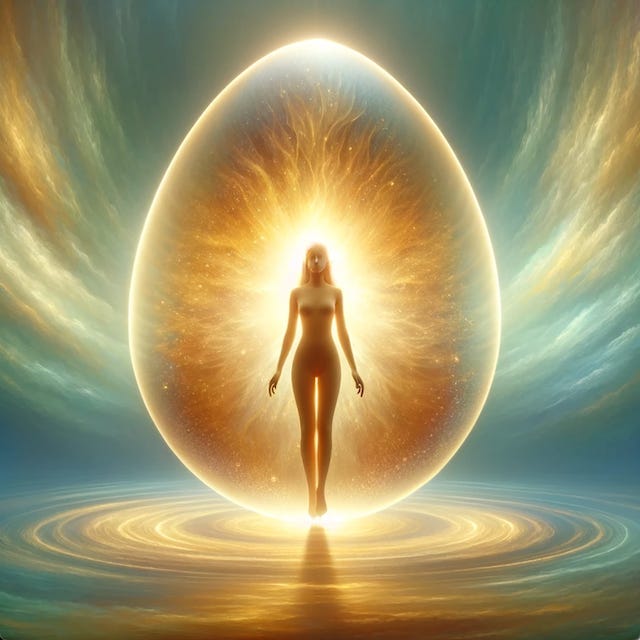
The luminosity of our egg can get weakened in many ways. African traditional healer and psychologist Colin Campbell once told me of the dangers of marijuana, for example, when contrasting it with carefully prescribed indigenous African entheogens: that it ‘blows holes in the aura’ fairly indiscriminately, and we have to actively invoke the sheath when working with such substances, or entities get in there that we don’t want in our space. That might sound too oogie-boogie for the average sceptical Westerner. But the weakness of this aura-space beyond the skin is one of the crises of our culture, that no amount of security guards for the bigger complex can cover up.
When we gesture our boundary, we naturally reach out to the edge of the egg, because any closer is into our personal space. Sometimes letting someone into that more intimate space is a delicious thing, but we all know when we’ve opened the garden gate or when someone with little sensitivity has just crashed through it. So even people with no declared belief in anything, beyond the physicality we can see, instinctively know there’s something else special to us but beyond our skin.
I saw the ‘thinness’ of this aura-space in movement classes I ran with the patients at a clinic for recovering addicts. Addiction is a classic illustration of the point made above: the energy of the addictive substance becomes malignant, filling the aura so that without it, recovering addicts are left feeling ‘energetically naked’. I worked with them on moving with the eyes closed, focused in on their own personal interior. After initial doubts, they usually found this a huge relief from external pressures. When I invited them to focus more on the wider room, but remain self-contained in their personal ‘bubbles’, this was virtually impossible for them: they danced their way towards each other, towards familiar external anchors. It would have taken a lot more time than I had with them to strengthen that personal field. Yet strengthen it we must, to become beings with a connection to the world but also our own sense of self.
It’s easier than we think, actually. A deep breath in a forest rejuvenates, as does a footstep through the trees. A dive into the waves. The natural world is always in flow, which is what we need to build this elastic strength in our outer bodies. Organic music, crafting living rhythms that echo that constant vibrating power our energetic selves crave. So if we’re finding our outer limits, it then becomes a foolish dance, a swirl through space that can excite and awaken. Especially once we start playing the game of ‘find the edge’ with each other. Learning does not happen in our comfort zone; it doesn’t happen when things intrude too much either, and we’re pushed out into the trauma zone. The juicy zone is at the flexible and listening brink. The liminal. Where we enter into a relating with otherness, and if our energy bubble is alive, we can do that without losing our us-ness. Contact improvisation is often described as dancing with body physics, but it’s much more than the physical. The push, the weight, the forms, the shapes, the spirals, these come from engagement; from a reaching towards the frontier, from an allowing of the other without collapse.
From a testing of strength. Is this need to find the threshold the original reason for combat? Adrenaline is designed for edge-finders, for those still in touch with that raw adolescent push towards whatever’s next, be it love, risk, death. Traditionally women would have found all of that in the risky, hugely yang process of natural childbirth; some have said that male combat arose as an attempt to give us an embodied experience that came somewhere close to that. Modern minds have overlaid this fundamental edge-finding with a zillion dangerous ideologies of conquest and defence, and I’ve protested against these attitudes reasonably often. Yet there’s also a dance in there that our ancestors had, before the unholy disconnect of modern warfare. That respectful bow before launching; and there are two ways to play with this from that point. Either, firstly, developing the skill with energy and power to compete, finding the jab and parry, avoiding with the duck and swerve, finally the uppercut that will lead to victory. Victory that is never final; even if it’s only the crumbling age of the victor, or the empire, that leads to the next generation’s new carving. Or, secondly, staying away from physical contact: instead dancing into the charged spaces between us, where the combat itself becomes a co-operation game. But it’s always a rush, playing on the periphery.
Sex at its best is of course a combat-tussle-dance-squeeze-improvisation-together game. A moment of immersion where well-defined perimeters help move us towards their dissolution. Electromagnets need two poles in flow: two beating pumping hearts that find their expression in both defining themselves and then in relating to another. And we truly know that sex also takes place in that space on our outskirts, with the potential for making electricity without quite touching, that makes the touch itself better when it comes. To return to our combat analogy, there’s something about the skirmish here: scouting the terrain. If we dive further into this salsa-dance zone of almost-touch we’ll also find (as we explored in the last Dimension piece) that there’s so much more double deliciousness to be discovered there. This kind of blows apart the whole notion of the discrete and separate self that Western civilization has been convincing itself of since at least the Renaissance. But that’s a minor point, perhaps. Sometimes David Deida has been read out of context and seen thereby as a much more conservative figure than his whole body of work shows him to be; his stuff on relationships and the vital polarities of masculine and feminine (without defining too much who needs to be yin and who yang) is good stuff for anyone looking to reset the game of two.
And it is a game of two, this edge-finding. There are other borders with the many that polyamorists of all persuasions might like to define, but it’s rather like the tesselation of geometrical solids. Even if there’s many other polygons surrounding our particular shape, each of them also gets a special frontier they alone seem to share with one of our sides. Close up, those borders blur into shared Venn diagram moments, that we all know of in relation to our special people. There are plenty of emotional and intellectual crossover points too; we may share a love of dogs, perhaps, with an otherwise grumpy uncle; or a delight in Italian opera with the neighbour down the road, but not their political opinions. Greek drama began, according to its own mythology, when two began a conversation, stepping out of the previously undifferentiated chorus to do so. And so the dramatic is different to the internal narrative of the lyric. Many ancient languages had a ‘dual’ form of nouns, to make distinction with the usual plural ‘many’ form. We seem to have collapsed this distinction out of linguistic convenience; have we lost something in our conceptual thinking though? Perhaps birds have inspired our visions of angels – humans with wings – because they seem to get this twoness right in their relating, whereas we mammals are often rather messier, much as we aspire to higher things. In fact we rather enjoy this messy blurring of the boundaries at times, especially us moderns, under such pressure to rigorously and impossibly define what makes our brand personal. The blur can be a serious relief, even if our egos still want to be special.
When I write, I imagine you reading. Yes, you. Obviously, I don’t really get you in the same way you would claim to. You have your own unique programming that sets you up to interpret these words based on your life experiences and what you brought to this world and dream of for its future. Both of us are reaching out to our outer rims to engage here, via a screen that pretends to be a solid barrier to connection, and certainly is doing its best to suck our attention to itself (herself? himself?) rather than allowing us to pass through it to seeing more of each other. Perhaps it would be better if I spent my time instead in cultivating telepathic methods of getting over my personal circumference. There’s a thought, bouncing back to me from the fringe. Which you may have noticed – from the name of this whole publication - is a favourite word of mine. I like semi-colons too; permeable punctuation, more flexible than a full stop.
Big thresholds, portals, edges are generally sought by adolescents and catered for in traditional or modern rites of passage, taking them to the outer side of risk but with a bigger social safety built in. In Steiner’s understanding of child development, the independent ‘astral body’ is seen as being ‘birthed’ around the age of 14, but it’s still rather fragile, like an astral toddler. Gradually the circles of healthy possibility can be widened by caretakers, as the young people demonstrate they can handle more of this power: so that they can push towards a more distant circumference, but still come back into themselves afterwards. Many of us remember moments of tipping over the brim, some of which in our day and age are sadly remembered on film for posterity, without the guardrails of traditional tribal societies. This wise observing of the unfolding towards adulthood comes with an awareness, too, of the fact that at the fringes there may be transformation; shifting of shapes. Shapeshifters in our tales are eerie, inspiring, diving into the outer mystery of what it is to be fish or beast, but with our own socially human kinds of awareness. We long for that connection but also not to lose ourselves, perhaps because at heart the truest thing we can feel about ourselves is love, and we don’t want this thing we love to get totally scrunched up and moulded into something unrecognisable forever. Though the other true thing is fear, and if we didn’t fear the scrunching up and remoulding, perhaps we could just love that whole process a whole lot more. Two poles, again, that let the unfolding dance, right at the outer shoreline, take form.
Sometimes we do indeed go further into the forest, and there’s learning there too. Yet this defining of the container of the self is an essential tool for that going beyond. It gives us a vehicle to go on with. A mobile temple. A Baba Yaga chicken-leg house, perhaps. It helps us be ready to play a whole lot more; it also gives us an appreciation for the fact that we may be on the verge of something completely different. Let’s keep seeking for that, supporting each other to tickle the outer contours of possibility.