Jazzy Jungles
Tales from the Bundu #3: Soil Songs and the City

Sipho “Hotstix” Mabuse is lighting up the stage and playing a mean sax from time to time, as well as singing and getting the groove going. It’s a huge warehouse otherwise known as part of the Cape Town International Convention Centre, and for tonight it’s been renamed ‘Kippies’, after the great Kippie Moeketsi, the alto sax player that helped shape a distinctive South African jazz. The last time I attended the Cape Town Jazz Festival was perhaps a quarter century ago, at the curious bit of old apartheid-era brutalism known as the Good Hope Centre, before the city invested in this shiny foreshore upscale. Back then, the wonderful keyboardist Josef Zawinul was building up a deep electronic but organic performance imbued with rich spiritual tones in the heart of concrete, around the time I was usually sweating in clubs to funk on the decks and in vivo. Round the corner from today’s CTICC there’s a club that still pumps tunes for the club crowd it seems, where my crowd had once danced our way through a rare December thunderstorm. And the club owners kept it going, though they had to pay high overheads to the protection rackets in what was then a seedier part of town. The serene lawns of the icky-historical Castle round the corner feel distant though strangely there's still more plant biomass round here, poking out of pavements and planters, than there once was. For this is all on the Foreshore, and was once under the waves, alongside hundreds of impressively-constructed wooden shipwrecks that are now buried in cement.
I had also gathered at the Good Hope Centre back in the day to hear Japanese taiko drummers gloriously thumping the biggest membranophones going. That was part of the Parliament of World Religions, when Desmond Tutu was still our local guru and my own encounters with mphephu smoke were few. The wavelengths of improvised music have been the way modern city life keeps the jungle rhythms and rhymes going, for more than a century now, and in South Africa we do have our own recognizable versions of the musical story alongside the breath from abroad. A foreign superstar called Jacob Collier is going to take the stage later tonight and team up with a woman whose voice is a heavenly combo of Bollywood and syncopation, his virtuosity joyful if a little surface-skaty. The Yellowjackets, whose music I once covered in student bands, are going to be on later, flying in from that mythical, other western coast land of California. Friends I haven’t seen in years pass in the dark and in the corridors. One has entered this unholy sacred realm of concrete from the backwoods of the Garden Route, and though I’d long since had him turning his nose up at cityscapes, here he is with his Gen Z daughter, his long beard briefly appearing more hipster than lone wolf, thoroughly enjoying the musical masala on offer.
And it’s definitely a confident and multiracial South Africa on show. In another room, a Zulu guitarist, Jabulile Majola: his band channels the groove of Sipho Gumede-type riffs with his guitar capturing the mbaqanga liquidity of the rural hills of KZN. The artist himself is no ethnic artefact, but a sassy, honest speaker into our hearts. This time the location is a massive conference room - a very long rectangle with fold up chairs. We had to queue for free tickets for this particular venue because “space is limited”. Given how huge this place still is it’s a little reminder that tonight is a big night on the local scene. Later Carlo Mombelli and his band will take the same stage, with their cutting edgy Jozi sounds. Class all round.
There is, in fact, an actual intentionally designed concert hall here too, which reminds me of the one at the Baxter (an auditorium under the University of Cape Town’s performance arts-based lower campus, where I’ve spent many hours both on the stage and in the audience). Except this is the CTICC so it’s much bigger than the Baxter version, and even so, only those extra queued-for free tickets get us in because “space is limited”. Abdullah Ibrahim has just been sharing himself here, reading Bushman poetry and communing live with spirit. South Africa’s most famous tinkler of the keys is now in his nineties: the hauntingly wistful sprite with a substantial ego and beautiful music to make up for it is now finding a deeper, quieter song in his final years. We missed his show, though I have both the echoes of the heavenly times I heard him before - like under the night sky in the theatre in Maynardville park - and feel the resonance in the stories we’re told by those who saw him tonight. Instead, we enter the concert hall to dream with a fresh young energy, a sax player from Leeds, that northern English city I briefly passed through last year. She talks disarmingly of the power of her music crafting process to manage her personal dark spaces. There’s a deeply vulnerable freshness in words here that I didn’t hear on the stage twenty years ago - when the notes held all the stories. We wonder, though, if that individual piece can ever be the whole story. Improvisation at its core tunes into everything around us. Even the shipwrecked woodwork under the concrete, the ancestors both human-and-more-than-human wanting their stories to be expressed, the energy of future forests that courses its way through the air.
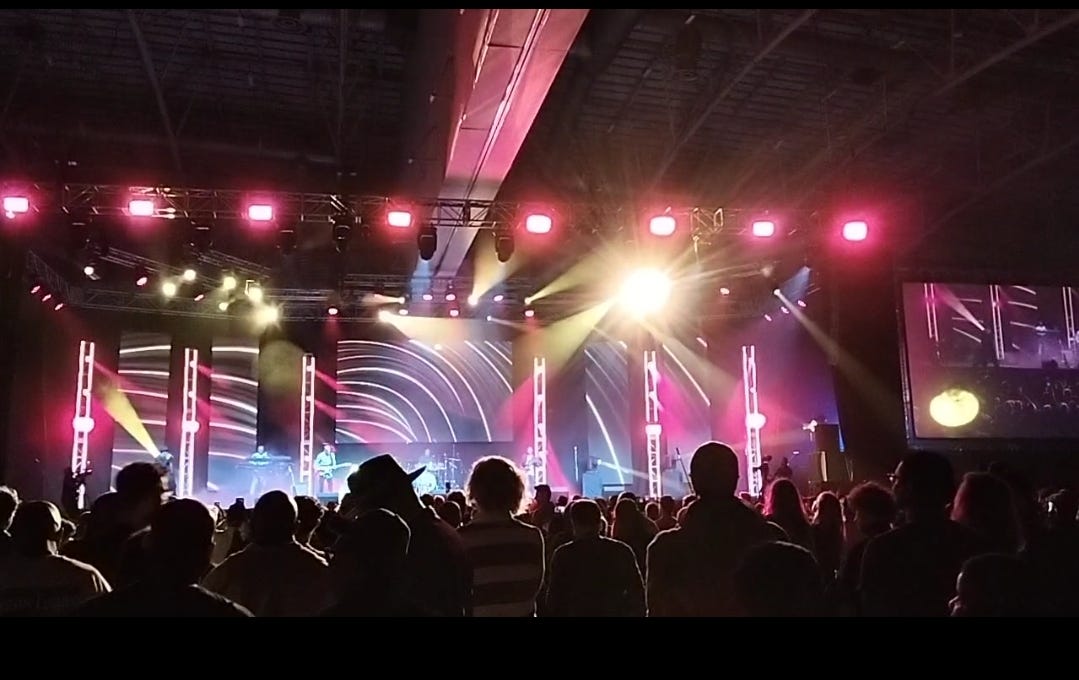
An air that leaves something to be desired, for all the creativity on offer. Perhaps it’s some kind of cheap air freshener coming through the air conditioning system, that has that sickly taste reminiscent of excessively sprayed teenage deodorant. The next night, Joanna and I will walk past a Loop Street art gallery and peer in at classic monochrome shots of some of the performers: the energy of this festival feeds out into the town. We sip on a cocktail each at what was once a club for sportsmen and is still furnished in a layered and rich colonial style. Poignant photos there on the walls too: rugby champions from the city’s oldest township. Golfers going walkabout with the poor. Techno beats pump out from other less stylish places, revving up the grey jungle into the early hours. A few years ago, walking down the then-barren city centre post-lockdown, the only thing greeting us was offers of dagga for sale. Now the city has its mojo back. And the marijuana is mostly sold from semi-legal snazzy shops. Up the road I remember my weekly gigs at the 2000s version of all this, Kennedy’s Cigar Bar, where pre-revolutionary Havana might have been the nostalgic moment suspiciously on display, but the mixed cast of customers were forging their way into a new Africa (the following morning, round the corner, was the first place in the city to start selling flat whites back in the day, a helluva name for a drink marketed to those claiming success in post-apartheid SA). Over the road was a classic club called, in brilliant confusion, Jozi, its grungy decor capturing the essence of the post-industrial deep North of the country.
It’s good, though, to find a way out of the highrise stew and back to the wild green, which we do a few days later. Breathing in the calming trees around Bodhi Khaya, a retreat space a few hours out of town that I last spent memorable time in over a decade ago. We’re here for Greenpop’s wonderful Reforest Fest. The link, however, to the previous weekend is live music, built in this case on an organic stage or sounded out over djembé beats while we plant - 8000+ indigenous tree beings finding new homes on a Saturday morning. The baby trees have all sprouted in Platbos, the ancient milkwood forest nearby, been rescued from over-competition there and are now given a second chance on the hillside here, no doubt encouraged by the older trees nearby, as Greenpop moves forward with reforesting the area. The huge fires this summer wiped out a lot of the introduced vegetation round here but the indigenous forest held its ground, a very visceral sign of resilience. This is a festival with a really wholesome feel: more kids, of all ages, than I can remember at a gathering like this, but not in a way that prevents adult conversations and connections from happening too. We are divided into a rainbow of different colour groups for planting in differerent sections, with the dressup part of the fun. Our colour group leader is perhaps a little too earnest about the ecology to also dive too deep into the cheerleader part of his role, but there are also gluten free biscuits doing the rounds for any flagging souls, and later some falafel-type nuggets. Meat-free is a conscious choice this weekend for reasons of ecological footprint, as the festival aims for the status of ‘Greenest festival in SA’. It’s not entirely alcohol-free, by contrast: there are organic wine tastings in the afternoon, and some ‘botanical’ spirits with wild flavours in the evenings. I loosen up with a wonderfully imaginative morning yoga class, and there are plenty of opportunities for all tastes. In spite of all the odds, us hippies do seem to have our shit together these days. We go for walks out of the campsite, finding echoes in the plant world that will help make the altar for our workshop. There’s a rain shower in the night and it’s cool in the mornings, though there’s also teas and coffees in the marquee and opportunities to talk about the world while the birds sing, or while the children swim.
The moles struggle a little this weekend with all the noise and all the tent poles: our shoes have disappeared in the morning under a mole cairn that’s magically emerged while we were sleeping. The Nomadic Orchestra are giving us their classic upbeat Afro-Balkan grooves; Crimson House power through the evening with a little gypsy roots juice. Of course, words can’t quite capture the vibe but what we hear is the jungle of original sound again, this 21st-century excitement that’s gone way beyond the novelty value of mixing genres (boereqanga and the like, if you were around in the early nineties) into finding the sounds of the moment from a wide palette of choices; and I think the quiet sounds of the soil are contributing to the ways the music echoes. There’s much more going on than just these big name musos; Swazi guitarists to Xhosa poets to a Japanese traditional dancer doing her thing (with fan) while we sang our national anthem, to a lengthy open mic round the fire that emphasized a rebirth of live human artistry. (My daughter assures me that this is now a key Gen Z concern). Sure, there were still electronic dancefloors up the hill on Saturday night, but even they closed down early enough to let the nature beings have a little peace. I popped up there early in the morning rather, to have a sauna by the pool and hear an enthusiastic young man talk about integrating architecture and permaculture in a way that should have been done thirty years ago, when those RDP projects were just getting going without a thought for meaningful sustainability in township dust bowls. There are plenty of formal talks, but often the best encounters are casual ones like this. And meanwhile there's the thick aliveness around us, reclaiming itself. Lily pads at one pool suggest the vibrancy of the forces in this land. I lie down to be bathed in sound, outside a grand tipi where a journey is being led, and I feel the filtered light in its own dance with the branches and the running stream. Bodhi Khaya is well-curated for sure: the tipi is not a patchwork affair, and the whitewashed buildings recall their colonial grandeur and peace. That’s being shaken up a little by the moles and the mycelium it seems, as well as the noisy bunch of us who've pulled in. Our campsite is a former paddocks, temporarily holding high-density humanity.
With the help of the energy here at the festival, I feel optimistic. Joanna and I run an introductory workshop on the principles of the Work That Reconnects, and find a receptive and engaged audience ready for the task. We have to feel gratitude for the creativity and beauty both of nature and of humanity. We have to be honest about the impossibly large state of the crisis we’ve reached as a species and the impact we’re having on all the others. We have to feel, too, the deep rooted connections between us all, alive now, those alive previously and informing our actions, those alive in the future and urging us on to deeper, more resonant connection in these times, as the musicians remind us; all the human and more-than-human beings. So that we can feel we can take the next steps. Planting trees of all kinds, and knowing there’s plenty of room for mischievous shoots to rise up amidst the concrete, from the memories of the ancient woods. Trusting the groove and the grove to take us where we need to go next.
I have some encounters, there on the ‘bridge’ where the tree-planting plan is outlined; not quite as unusual as the leopard photos from the deep forest that are on display. But still, with globetrotting friends that I haven’t seen for years and catch up with as if it was yesterday that we last hung out. One of them is only here because of the synchronicity of cancelled flights, with the horrible dramas playing out in the North. This is also the case a week later, when I dance, for the whole weekend, with Ya’acov Darling Khan and old friends attending his workshop unexpectedly. We dance with a Tree of Life in the centre of the sprung floor, and my body remembers, again, how it is to be a human, creatively, in community with ourselves and the beings of the world, and how to include the imaginal in all that. I’m back in the city, even if there are rabbits and trees and nature echoes all around at our movement venue. Somehow, DJs who do it with consciousness, tuning in to the needed energy for the particular group at any one time, are fulfilling something approaching the magic of the wise shaman, a magic which the forest’s patterns are in synchrony with. Helping us to shake off old skins and find new prayers for this time of year. A time when I need once more to enter the dark, to trust the messages that the worms and the soil might have for me. Armed with the knowledge that by getting my fingers once more in the soil, I have helped to honour that essential aspect of our lives, upon which we usually casually tread.
In the course of this particular Movement Medicine workshop, where we dive deeper into the true meaning of Ecstasis - a reaching beyond oneself - and looking back at these events from the previous weeks, I’m called to be more grateful, more consciously present to my surroundings. To realize my connection with what surrounds me and thank it. Ya’acov brings simple medicine from the forest with him. Another man I converse with now tells me he takes a little soil from place to place, to build the conversation between soils. We might not know what they’re saying, but they’re teaming with life and creativity, so no doubt it’s grounded and profound! Some say the Amazon itself is planted. The core soils that generate food plants in the heart of our greatest forest are strangely different and irreplicable. They remain a puzzle to enquiring modern scientists, even if the guardians of the forest know their own lore. That’s a story of human endeavour and creativity, trusting and connecting with the beings beneath our feet that give rise to this whole sense of place around us. A game truly worth playing. I genuinely have a sense that the music we create above ground is an echo of what lies below, and perhaps we need to build more archaeological lives, digging in without disturbing the process, to witness with astonishment what lies there and connects us all, so that we can improvise like forests do.