
Lusophone Loitering
Expedition to Atlantica #5: A Portuguese Interlude

And so, the expedition moves across its first border, out of Spain and into Portugal. Differences, and similarities, to where I’ve just been. If you missed the first sections, they’re all here. They’re also available in audio form, here and here.
We’re on a tram with antique wooden fittings circling the old Moorish quarter, and heading to a big square where there are lots of Africans sitting on benches, laughing and chatting in easy Portuguese. Here we’ll jump on one of the four primary-coloured metro lines, to pick up our belongings. It’s early afternoon in Lisbon, where we’re so far west that I will only get further west many weeks later, on the remotest coastline of Ireland. My watch has gone back one hour, so the sunset won’t take quite as long as it could have done, but the evenings are still long. I recognise the words on the signs, but am feeling pleasantly confused and scattered here, where the main language is not one I’m expert in. Still, it’s one I’ve heard frequently in Africa, is not unrelated to the one next door where I’ve just been, and I will have a ham-fisted go at speaking it myself at times.
Today, however, began with a reunion in Lisbon airport, where my daughter Zorya has arrived in Europe for the first time since she was a little girl, and in a new country neither of us have been to before. So I’m seeing many things through the eyes of youth: beginning with her impressions at breakfast, which we took on the deck of a classic bar, served on a tiered platter by somebody we assume is Brazilian, but might be Angolan or Mozambican - or from some other former colony that retains the Portuguese language and is transforming modern Portugal. For this country that was poor and on the edge of Europe is becoming dynamic and international, if still distinctly lusophone. That’s the term for Portuguese-speaking peoples, and with fairly flexible laws on citizenship and residency for those from former colonies, we’re in a noticeably cosmopolitan city. The manager of our hostelry corrects my inadvertent Spanish: there might not be as many Portuguese on this peninsula, but they have their own distinctive world-changing history. A few weeks earlier my Angolan housemate in Cape Town had become enthusiastic knowing we were coming here: her own family has property a little further along the Atlantic coast.
We wander into a bookshop, one of the largest in the capital. A moment a little like one I had in Madrid: taking in quite how much stuff is written in Portuguese, and I don’t really know where to begin. To be honest, as we’re only here for five days, I don’t think my Portuguese is really going to get up to speed enough for a book to be worthwhile, with the exception of a pocket dictionary. Of course, in southern Africa we’re pretty used to seeing the language, as all major international packaged items come in English, Portuguese, and sometimes French, the three most popular languages in our region. I’ve had many Portuguese-speaking neighbours over the years, for the connections are strong: I played with Mozambican musicians frequently in my years on the Cape music scene, and often with a lovely Angolan guitarist. I’ve visited plenty of Portuguese shops, and eaten southern African approximations of Portuguese food (often with peri-peri sauce, for the Portuguese are not as spice-shy as their Spanish neighbours; the famous SA fast food version is Nando’s, who’ve expanded into the English-speaking world, but which I mostly know because of their witty adverts). I have had many plans to visit Mozambique – or even Angola – that have come to nothing so far, but which I’m definitely going to action one of these days. Zorya has already been to Angola, though just for a few hours to await her connection north, as Angola’s TAAG airlines is proving a popular route, especially if you want to reach other lusophone places.
We head off to visit the design museum, on our way along the street to the grand arch on the Rua Augusta. A blast of first world 20th century design, and relationships to traditional Portuguese cultural forms. Those azulejos – mostly blue and white tiles - which I saw at an industrial scale in Seville, are the famous Iberian contribution to art deco style, and indeed many other design forms. There are however none here: there’s already so many tiles in this city, and indeed this country, to be seen elsewhere, including in their own museum! It prefers to get right up to date, with local YouTube popstars aiming to incorporate dress and song and lyrics from the past into something of the present. As well as a retrospective look at Vivienne Westwood’s work, the English haute couture designer who was part of launching punk. It’s a blast, and another way for us to acclimatise together to this continent. More Portuguese, of course, are the pasteis de nata, a little like Afrikaans melk tert but rather more crumbly and with a thicker consistency. We make a commitment to have at least one of these a day while we’re on our short trip to Portugal: pretty easy to manage, because although guidebooks will tell you you have to go to special confeitarias and stand in queues, there are pretty delicious ones available at stands all over the place. And even passable ones in the supermarkets. These are often (as in Spain) branches of a famous French chain, though we hold our nose at the multinational capitalism from time to time for the sake of convenience shopping.
Another cultural element in Lisbon is fado, which is the classic way of showing the generalised difference between Portuguese and Spanish culture. Spanish friends told me they loved Portugal but the people are ‘sad’. We’re not really getting that, and I’ve been in much more sombre cultures, but perhaps they’re less dramatic than the average Latino! However, stick fado next to the driving, energetic rhythms of flamenco and you’d have to acknowledge they’re completely different styles. The melancholic, haunting melodies of fado (which means ‘fate’) are sometimes said to be connected with women calling for their seafaring menfolk to come home, which is fair enough in a nation that’s almost all about its coastline. However, it’s also very connected with the Alfama district, on the side of the hill where we were catching the tram: the old Moorish medieval streets, which became a centre for emigrés from the colonies, particularly after Brazilian independence in the 1820s. (In complete contrast to the earlier republican birth of the USA, Brazil’s post-Napoleonic independence was organized unilaterally by the king; literally the son declaring freedom from the father back home. I have yet to satisfactorily decipher all the shenanigans between Portugal and its larger ex-colony, but Brazilians of all hues have been in Portugal for a very long time!) In late June, and with two days to explore, we figured it would be too hard to find fado away from the tour-torrent, though we occasionally heard lovely string sounds and voices wafting through the upper streets.
Lisbon is a very quirky capital, because of its shape, and its slopes. The famous public funiculars and even a public elevator are all integrated into the transport network, as well as the buses we hopped on. The contours would be lovely if we didn’t have a few of those interesting holiday hitches happening. Zorya has a temporary health issue that makes her less of a strident hiker than she might otherwise be; and her suitcase handle has decided to shorten itself dramatically so that we’re hunching up to drag it up hills and over extremely decorative diamond-shaped cobbles that resist suitcase wheels. We do get there in the end, but not before I’ve left my day bag on a metro bench. Wonderfully, when feeling a bit more spacious the next day, we head up to the lost property station in an outer suburb, and there it is, handed in. Rather more efficient than South Africa, and thankfully less efficient than the UK where it would probably have been blown up. So, with our peace restored, and recognising that Lisbon’s slopes are calling us to slow down in a way few other capital cities will do, we go exploring once more. And get trapped in the tour-torrent after all, at the Time Out market.
What the London listings magazine Time Out seems to have done is taken a busy, lively pre-existing food hall (a grand version of the many we have in Cape Town, one of which has also been conquered by Time Out); and make it more commercial and bland, in a thoroughly unnecessary and counterproductive bit of multinational taking-over. Boo hiss. We wondered whether anyone eating there was actually Portuguese any more, which was a little eerie. The fish was good, but honestly not as good as our second night, when we sought out a lovely backstreet restaurant, with Benfica soccer club tops on display, and Portuguese telly on in the background. That seems itself very quaint, sharing top tips on current museum exhibitions, and leaning in to very regional culture by doing roadshows in different small towns across the country to catch up on local ‘stories of interest.’ Sounds lovely and worthy and fitting for a small-enough country, around the size of our province of KwaZulu-Natal (which the Portuguese were the first to call Natal a long time ago at Christmas), and with a slightly less dense population. Where people can at least make a decent pretence at being all in it together, without being on top of each other.
There are seagulls here: and we can smell salt. It’s good to be back at the coast, and the fish is fresher than you’ll get in most big cities. Indeed, when people talk about the past and Portugal’s maritime empire, that’s really what Portugal was. All that gold and colonialism could feel a little theoretical in the inland Spanish zones I’ve been to, and even at Jimena I could see the sea but not jump in it. Here, there’s an enormous sculpture of a caravel with images of all the nation’s favourite pirate-colonial bastards, I mean global discoverers, and a big map of the world and where they travelled. That includes the Cape, for we have a reconstructed caravel on display just down the road in Mossel Bay, where the Portuguese maintained a post office for centuries. Well, a post box tree kind of thing. Anyway, Diaz came round there, beyond the other bay they’d already labelled ‘Saldanha’, pronounced incorrectly since then by generations of Cape locals. He stuck lots of Catholic crosses all over the African coastline, or something like that. Here in Lisbon, we also see Vasco da Gama’s actual tomb in a church here by the waterfront, which is marginally more tasteful than Columbus’s in Seville. I mean, the stories of the risks these guys took is certainly worth remembering, whatever their general behaviour to natives and the later economic and cultural impacts: kind of ‘Viking bastards 2.0’. And remember them we do, in suburbs like the one round the corner from me, where little boats are pulled up, in ‘Marina da Gama’, or, elsewhere nearby, quaint names like Caravel Street or Corsair Close, which is a bit more on the money. Ho hum.
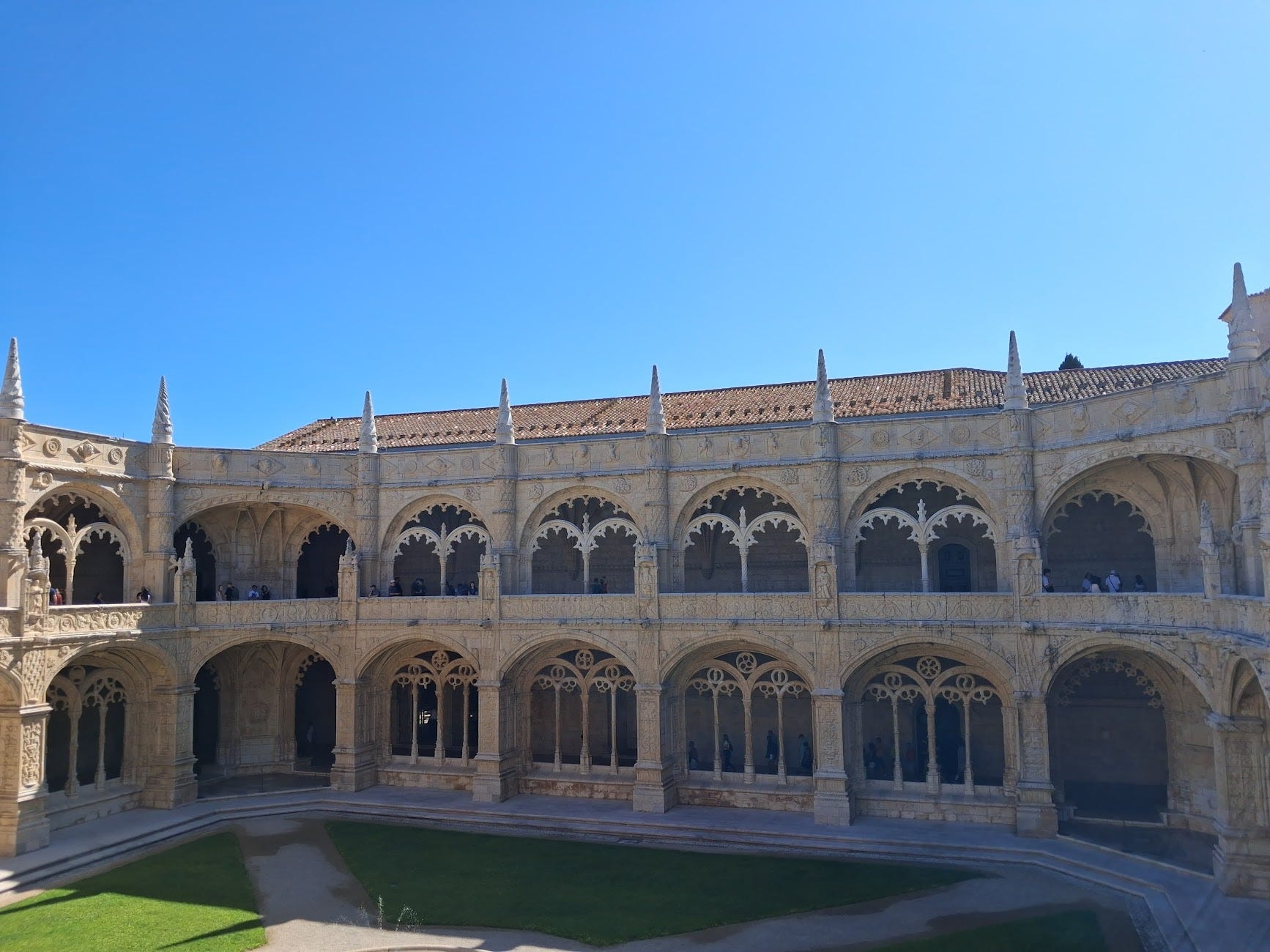
So we South Africans probably view the whole thing with a little more irony than your average European, who might just see the sign for the Treaty of Lisbon, with presidential signatures from the whole European Union. That’s outside the gorgeous Renaissance Hieronymite monastery, near the port where the ships would come in, and where the king who received all the bounty of the Portuguese trade-at-gunpoint in the east had agreed to reconstruct the site. King Manuel gave his name to a distinctive style that centres, really viscerally, on thick rope formations in architecture. There’s no pretence at anything other than glorification of the sea trade, really. Sumptuous, opulent, and surprising, given that the monks here (exactly like at El Escorial, Philip II’s palace/monastery outside Madrid), were keen to revere St Jerome. For the ‘Jeronimos’ were not followers of the famous Apache leader and Wild West movie cliché, but of the Egyptian Desert father hermit, who I know more because he tamed a lion, and took a thorn out of his foot, than anything else. (A lovely naïve story to tell kids in grade 2 at our Steiner schools). Famous within Christianity for renouncing everything and only agreeing to be more than a hermit when he was repeatedly pestered by potential followers, which I imagine rather like Brian’s experience in the movie, though more spiritually pure obviously. Anyway, here we go again: kings making the most of their ill-gotten gains to promote the most pious of the pious. In the old refectory, there’s a whole series of biblical stories told in a few lovely Enlightenment-era azulejos. It’s a secular state building these days, which is why something as blandly bureaucratic as the Treaty of Lisbon could happen here, I guess, and why we can take selfies on the balconies. The previous religious buildings here were under different management: that of the Order of Christ, the successor organisation to the Knights Templar, who were burned famously in France but remained rather popular here in crusading Portugal.
It’s almost as if all that crusading energy had to go somewhere, and Prince Henry the Navigator knew where to channel it somewhere new, now that those foreign heretics had been successfully massacred and evicted from here in the name of piety. The county and then independent kingdom of Portugal was originally based further north, on the two banks of the Douro river, and the capture of Lisbon from the Arabic rulers was the only great ‘success’ of the second crusade in the 12th century. Accompanied, according to written accounts, by the usual completely barbaric behaviour on the part of the knights involved. This bloody history was something we see in reverse (of course) in a Porto church, dedicated to St Francis, though with Templar crosses all over the place, intriguingly. An intricate altarpiece in one of the chapels, showing peaceful Franciscans getting speared by Egyptians they were trying to convert. Though also a rather squat, medieval-style sculpture of Francis himself, dating from the 13th century, which is extraordinary because that’s not long after he was alive and preaching. We’d previously visited another baroque church in Lisbon, which was likewise full of intense detail, and dedicated to St Rock, he of the plague victims, which a big city like Lisbon was full of from time to time. If I’d enjoyed plenty of medieval things in Spain, here in Portugal we were mostly being treated to the ridiculous detail of the baroque. In Lisbon at least, this is because pretty much the whole city dates from after 1755 – the biggest earthquake in recorded European history, and perhaps a fitting way to crash an empire if you’re a vengeful god. Which the Christian God isn’t supposed to be but – never mind.
In the Porto church, there is also a ‘tree of Jesse’, a kind of visual version of a begat b begat c begat d featuring, as Zorya is quick to point out, very few of the actual birthing mothers along the way and a lot more of the menfolk mentioned in the Bible. But Anna and her daughter Mary do get a look in, sometimes even in pride of place. It’s an exquisite bit of craftsmanship from the days when workshops were really enjoying this way of playing with the human form and its relationship to the vegetable (or the mineral stalactites), in a more ‘organic’ way than the exquisite Mudejar geometric forms I’d seen in Andalucia. I still think the elaborate artistic cultures of the Americas had a lot to do with where Spanish and Portuguese artists went in these centuries stylistically, even if the Tree of Jesse as an idea predates the voyagers. Catholic Christianity is still very definitely the top dog religion round here, and we were told of little local rituals, involving priests blessing your house in return for a little tip or two on festive occasions. But the nice thing we both liked about churches was, even if you don’t know much of their particular faith, they can be cool, peaceful places for taking a breath and connecting with spirit. Francis is shown a few times lifting up the crucified Jesus. There’s a sculpture of Saint Isabella too, the queen who prevented war a few times in her reign, and I find myself in tears looking at it. Something bubbling up unexpressed, whether from the atmosphere here, or called up from other lives, or deep in the soul. There are stories in the letters in the nearby archives too: of Franciscans from Brazil and other colonies, writing to hope for a welcome when they arrive here. Many of these ‘orders’ were attuned to international travellers. That’s maybe why we keep feeling so welcome in their churches!
Portuguese Catholicism does seem to be a little less showy than in southern Spain. Some of Lisbon’s churches look pretty unimpressive from the outside, almost hiding the majesty within; they reminded me strangely of the Greek Orthodox cathedral in mostly Muslim Istanbul. But in Porto some of the churches have in recent centuries decorated their potentially bland outsides with wonderful azulejos, which suddenly recall to me that I’d seen them previously on churches in Puebla, that Catholic/ceramic capital of old Mexico. Here there are whole walls full of scenes, visible from the outside whatever the weather. Porto’s cathedral is likewise covered in them. This is the magic of these more industrial-era tiles: they preserve their images so much better than, say, the medieval tapestries I’d looked at in Spain, or indeed the world’s oil paintings that teams of restorers have to keep working with. There are colourful modern ones by the metro station near our dwelling. The most impressive tiles are, however, covering the walls at São Bento station, and telling Portuguese history. At least as many people are coming to look at the images as to catch trains.
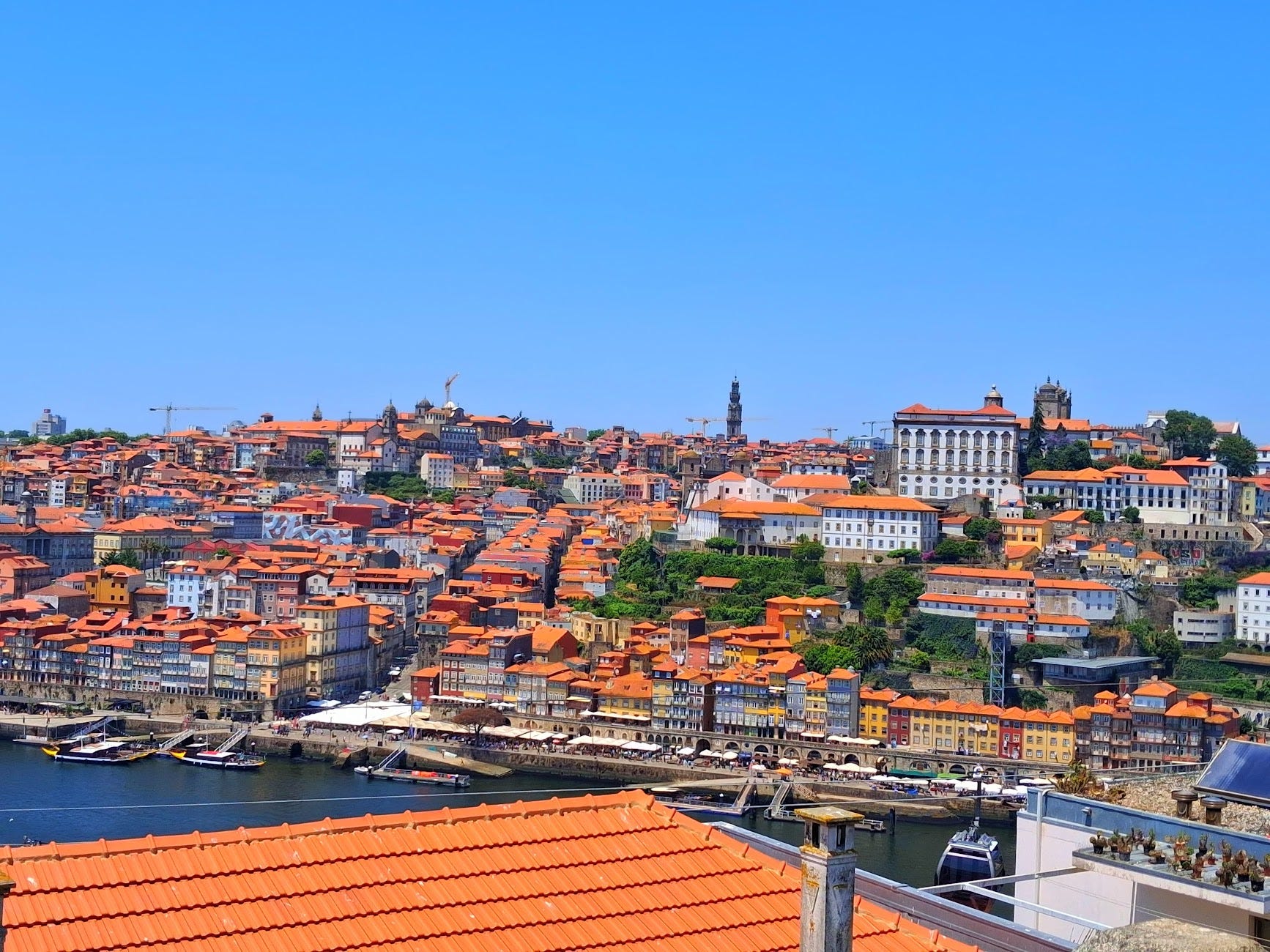
We are in the north after a shortish, fast and straightforward train trip from Lisbon, through this slender and well-forested land, arriving with amazing vistas in this double-city of two slopes (both down to the river). Another Iberian place where artisan regional varieties of fish, meat, cheese, and booze are waiting to be sampled. And the bird the English call “turkey”, which in French is called “dinde” – ‘from India’ (in common with many other European names for it), and in Portuguese is called, with much greater geographic accuracy, “peru’. The local food market has a few signs of tourist-weariness, like “No Photos”! The tourists are continual here now: we are lucky enough to have family willing to host us here, who can share how the city is changing, suddenly on the northern European map, and increasingly the global one. One of their favourite local restaurants has recently been inundated with Korean tourists thanks to a favourable review in a Korean guidebook. I imagine the strange flows and eddies of this expanding tourist river, as I’m gazing down at the actual river, from the incredible height of the tram bridge over it. Porto is bustling with life on this sunny day: down at the Ribeira there are Brazilian musicians singing samba and overflowing cafés gazing out at the banks. We’ve passed a wrought-iron market place, given new life with a series of millennial entrepreneurs at their stands: all sweetly ‘established in 2024’, with original variations on Portuguese cultural themes - earrings and cotton shirts and other things my daughter is keen to take time looking over. We’ve gazed over the town, where beautiful but run-down buildings are being turned into chic apartments, though the roofs of others are still full of holes. Porto is on the up once more.
A Sunday experience: wandering around a lovely old park or two, with peacocks in the trees and a concert venue straight out of ‘Close Encounters of the Third Kind’. Hearing a local saxophonist blasting out a range of impressive genres by a classic bandstand under the shady trees. Eating fish and chips (Portuguese-style) at the coast, and having, at last, my first sea swim, in the warmish waters on this side of the Atlantic. We’ve had long warm evenings of engaging conversation in the lush back garden of our hosts, with flowers and cats and the soft smells of summer. The whole of Portugal is a lot more temperate and manageable, it seems, than the equivalent latitudes of Spain, with the fresh winds off the coast making it very pleasant.
One of Porto’s previous ‘up’ moments came thanks to the British, and the infamous ‘oldest alliance in the world’ between England and Portugal, which is marked in Porto with a big politically incorrect sculpture of the English lion crushing the French eagle (dating to the time the Bonapartes were kicked out with British help). This alliance came in handy for Porto, because the local fortified wine could reach the south coast of England without going off, whenever French stuff was off-limits because of war, and as we wander we see the warehouses and old customs offices from the heights above, many of which have unexpectedly English names. Atlantica has been a thing in the collective consciousness for a fair while, it seems. There are lines of energy sweeping down the Douro and out towards the wilder north. For today, though, there's tranquility and human warmth.
For many reasons, I’m delighted that we’ve been here, not least because of Mike and Lenka’s enthusiastic willingness to host us and connect; though it’s been too short, and the other possibilities of this country – beyond its two biggest cities, though delving more into them again – are inviting. The forests of the north of the country hide many stories, and it would probably take a pilgrim's steps to reveal some of them. Instead we board a bus and get glimpses through the canopies. But we will be back!
More lost and found property!