Patchwork Counties
Expedition to Atlantica #13: Kerry to Tipperary

Another month, another island. I’d landed in Ireland with my father and was ready to explore once more a country I knew very little. This is part 13 in my series exploring the five countries at the west of Europe. You can find all the previous articles in this series here, or the audio versions on the podcast.
There are lovely flowers all over the west of Ireland this August. The roads are single lane for the most part, but we manage; we’re not in a hurry, thankfully, and it appears that neither is anybody else, certainly not the tractor drivers. Many tractors seem to be driven by boys of about ten – perhaps a little older(!), but clearly learning their family trade and getting their kicks in the same activity. Elsewhere I’m told there are definitely mag racers around à la Cape Flats (or Exmouth at night). Some of the land is parceled out illogically, following centuries of, let’s face it, a lot of rural tragedy, usually at the hands of the British and the proto-British before them. The flowers it turns out are often invaders too: red japonicas, orange African irises, and, though they’re not flowering at this time of year, rhododendrons, all of which thrive in this kind of moist climate. The flowers are on all the verges, and they’re occasionally whacked by overprotective landowners with weedkiller; not the best solution to something that dies back annually and is beautiful, even if it’s a little excessive at times. On the other hand I find it a little insane that there are places where the rhododendrons are actually protected, because it’s obvious to me as a South African that they are clogging up the natural flow of things, particularly in some of the water courses. They must be seriously pretty when in flower for the average bureaucrat to feel justified protecting them, though that’s not at this time of year. I guess Ireland has so much water that it hasn’t really considered the effect of so many plants from elsewhere, and they’re still generally proud of their pretty exotics. We don’t see too much actual boggy land this August, but I do hear of some, where a local drowned himself some years back. The hidden horrors; just one set of Irish stories, of which there are so many, it’s as if the land offers up story as the human version of flowering. On the west coast, it’s chilly, and Inch beach is not exactly a resort that makes me want to sunbathe. The average summer maximum temperature out here is a ‘pleasant’ 19 degrees. We are well into the 50s latitudes now, which down south would mean the middle of a cold ocean near Antarctica and not much more. Here, though, we’re close to the Gulf Stream that keeps Atlantica unusually warm: so there are some surprising microclimate places where there are tree ferns and palms and other weird tropical things happening.
South-west Ireland has five fingers, five peninsulas stretching out into the ocean, and we’re heading down the one that’s furthest north and perhaps most Irish-speaking. In Dingle town there’s a republican monument involving Jesus and Mary, because the Catholic church here has a somewhat different history to Spain. No rightwing Opus Dei types around here: instead the local Catholics were fighting for religious and political freedom. I hear what I think is probably sports commentary, pumping out on the Gaelic radio station in the public loo. Though which sport I’m not entirely sure. County Kerry is keenest on Gaelic football, and there’s a youth team practising on the field one evening opposite the little place in Blennerville where we’re staying. Apparently the Kerry men’s team just won the All-Ireland final at Croke Park in Dublin, so there are Kerry flags all over the place. Gaelic football involves a goal with a net and a keeper, like soccer, and tall posts like rugby which you can also kick points through. Apparently, of the various ball games, it’s closest to Australian Rules Football, and each year there’s an Ireland vs Australia ‘world rules’ match. The rules were established by the Gaelic Athletics Association, which turns out to have been a major cultural force 150 years ago, inspiring and pushing for Irish independence. Sporting codes holding matches at Croke Park have to be entirely amateur, and entirely not based on British sports rules. And they seem to be impressively popular, if the flags and the cheery messages are anything to go by; real ‘local hero’ stuff, warming the heart more than, say, some international soccer player working for a team he has no cultural connection to.
It’s also in Dingle that we manage to pick up some decent vegetables, which we struggled with the night before. Our accommodation, though, is full of thoughtful little extras, and more “welcome” signs than I’ve ever seen, extending that western European notion of excessive numbers of collectibles into an area I hadn’t previously considered. This is rather different to what early peoples might have experienced. The south coast of the Dingle peninsula has a bunch of ‘ring forts’, which is again that archaeologist shorthand for not really entirely knowing what they are. “Fairy forts” is the traditional translation. Belief in the sidhe, or fairy folk, has long roots, and why not? There seem to be tales everywhere in Ireland of invisible spirits, including the leprechauns (an equivalent to which is seen regularly in west African initiations and ayahuasca trips, and of course in those who think the little green men they’re seeing are ‘aliens’ from other planets rather than – as I think more likely personally – other dimensions of reality, perhaps what Irish tales look at as the underworld). However, these particular forts are rather solid, dry stone constructions, some of them here on Dingle ridiculously impressive and on the wild edge of nowhere, with goats and sheep and pigs to be petted and fed if you’ve had enough of the ‘Bronze Age’ bits. On the other side of the peninsula, around Mount Brandon, which we can’t see today in the mist, there’s the Gallarus chapel (or ‘oratory’); the most wonderful dry-stone construction. A quote from poet Seamus Heaney tells us what the purpose for the old monks (or other spiritual users of the place, whoever they were) must have been: going into the still of the dark, the better to appreciate the light on re-entering the world. This, it seems to me, is the point of all these inner temples I’ve been seeing, ever since the contemplative places of southern Spain, and surely it’s the point of the ancient barrows I already saw in England, and which Ireland is apparently full of. The links to the ancients continue to grow.
Nobody truly knows who built the Gallarus oratory, but its upside-down boat appearance certainly recalls the more ‘beehive’-type structures we already had seen that day. And links this place a little bit to Brendan, the most evocative figure of west Kerry. St Brendan may, or may not, have headed off to America in the early days of Irish Christianity: he certainly had an Odyssey of journeys if the epic tales about him are to be believed. I told some of his stories back in my primary school classroom twenty years ago. He evidently was keen to ‘get away from it all’ like a lot of these west-facing peregrino hermit types; (a little different to those who instead left Ireland to preach in continental Europe, rousing the ire of Popes on what the Papacy considered its home territory). And quite probably he was involved with the monastery on Skellig Michael – that most westerly point of the ‘Sword of Michael’ arc I previously mentioned, running down through Mont St Michel and on to Israel. Which today, rather appropriately, is more famous for the elderly fictional hermit Luke Skywalker. At one point on Dingle, we see an impossibly large collection of cars parked: there’s a small sign saying “this was a location for the Star Wars movie”. Maybe so, though not the Skellig Michael scenes: that island is far away, off the next peninsula down, and costs a fat whack of euros to get to, even if the weather’s good enough, which it isn’t. However, there are always Irish people ready to make money out of gullible US tourists. There’s also some dry stones arranged on our route, to form sculptures of Yoda and Darth Vader. Ancient times, indeed. There are mossy dry-stone walls all over the place, and the next really big set I’ll see are at the incredible “fort” on Inishmore that I don’t think is a fort at all. Why on earth would people be defending themselves so strongly, up on a cliff far from anywhere, facing the sunset, on the western edge of Europe, with an amazing amphitheatre and an ocean backdrop? But a “fort” is the mainstream archaeological claim for Dùn Aonghasa, on the largest of the Aran islands, which I cycle to on another typically misty, rainy day a week later. Being there, sensing the energies swirling, the platform that looks like a stage, the different levels of dry-stone building, it’s pretty obvious this had some primal spiritual purpose, to some people, some time. Who even knows when. You can’t carbon-date stones. They could have been here for millennia. My archaeologist friend Matt, who I’d been to Avebury with, prefers working in the recent past these days, so frustrated is he by how much assumption is made by his colleagues about the ancient past. Forts and tombs. So much that I see in Ireland (and have seen in these kind of sites in England) suggests some people feeling, experiencing, honouring the sun, in ways we’ve kind of forgotten. And of course in the west of Ireland, seeing the sun at all is often rather a blessing, which people comment on endlessly when it comes out.
Incongruously near a riding school with fancy grounds, we find a few Ogham stones, by some ferns in the rain. These tend to be ancient standing stones that have been carved with Old Irish language text that has a complex numbered-notch-based alphabet, often declaring ownership or sometimes something a little more Christian. We saw one in the museum at Ardfert’s ruined cathedral; and another one, with a rather phallic cap, in a graveyard in the south of county Cork. (The story Paul Kingsnorth repeats about that one is that you’re supposed to put the ‘cap’ on your head to cure a headache, which seems like an Irish kind of yarn.) There are loads of other standing stones in Ireland too that still seem to be in their original positions. Like, really a lot. We find more another day on the Beara peninsula, further south. On this occasion, the sun is out enough for us to take it all in: a magnificent landscape for grounded spiritual experiences; five stones, arranged at different angles to the earth, allowing space for interacting with the surroundings. There’s a fresh lough nearby to dip in too, and blue dragonflies, and butterflies, and natural silence. We had driven down here via the Killarney National Park, which was a different thing entirely. A beautiful waterfall, a forested hill walk with rowans sticking out between the beeches, hollies and oaks. I’m gradually getting the hang of these northern trees. But also – plenty of people, who are otherwise largely absent in this peaceful part of the world. The national park, and the Killarney area, felt familiar: Killarney is twinned with Keswick in the English Lake District, and there were lakes and holiday excursions and a place called ‘Ladies’ View,’ where Victorian ladies would once have stopped to take a look. It was all rather magnificent, yet it was also more manicured than on Beara; we would really have had to head far into the mountains, I think, to escape the day-trip crowds. And in the heart was Muckross House. We didn’t visit it, but it sounds like exactly the kind of place that marked the ‘Protestant Ascendency’, when Anglo-Irish lords were in charge of ‘Big Houses’ across the country. Perhaps owned by a lord and lady Muck. There’s a range of rather different (and smaller) ‘big houses’ popping up now, it seems, often attributed to local councillors and other bigwigs in the new Ireland.
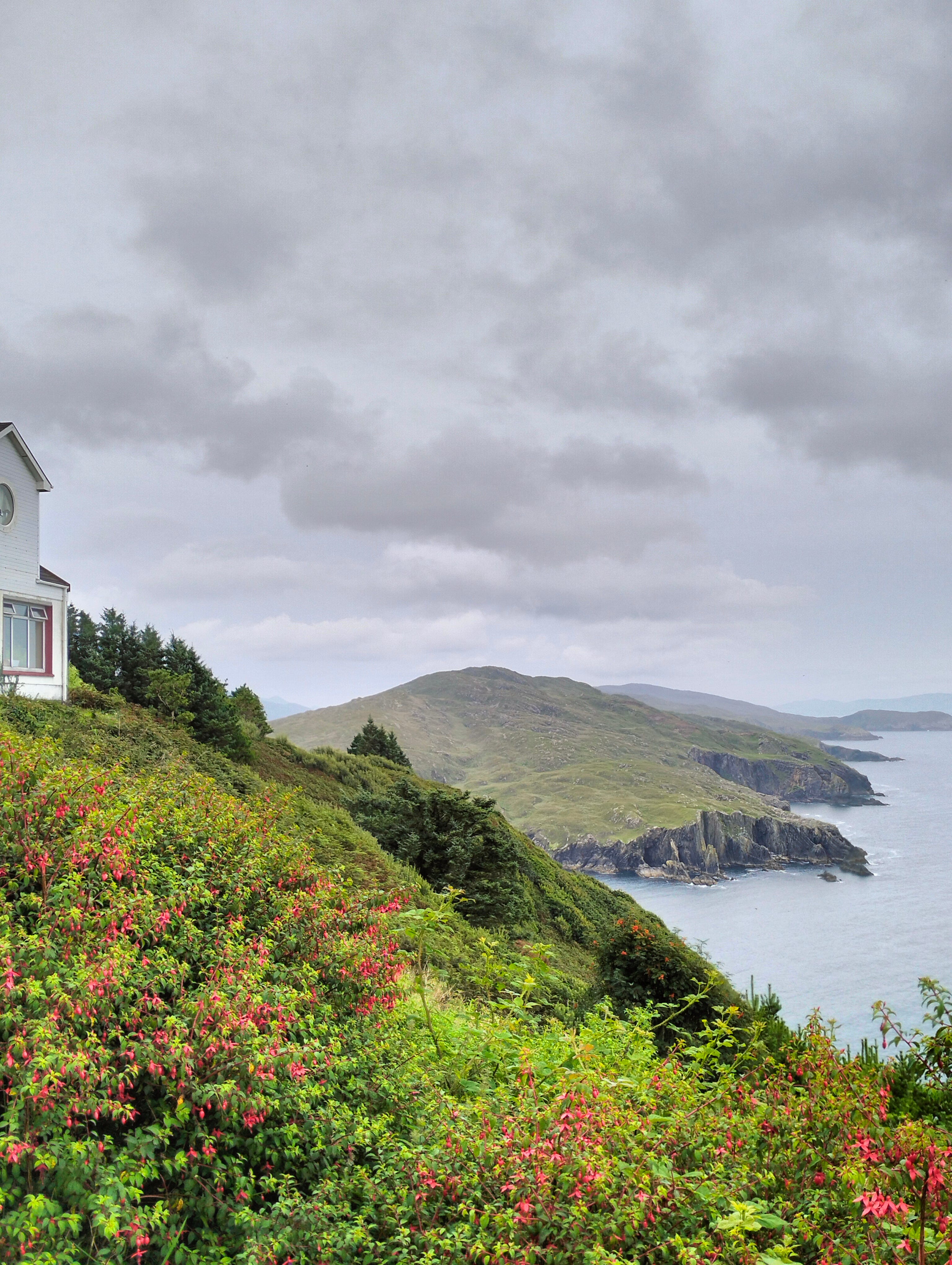
The edge of Beara takes you out to wild rocks, left in place. My sense, driving around there, is that the land itself calls to remain wild, to force us into accepting her as she is. There’s a Buddhist retreat centre out there, with a view out to the south, to county Cork and the Sheep’s Head peninsula that is the next finger down. And on this long summer evening, there are Irish people sitting in shorts outside their local pub at the end of nowhere, pretending they’re in a warm Spanish street perhaps. Shame man. We drive north, back to Blennerville and its very indoor pub, a great place to get a velvety pint of Guinness before bed: one cliché I’m happy to acknowledge is that Guinness tastes better in Ireland. Must be something about the water. Tralee, which Blennerville is just outside, is a student town, and there are a number of Indonesian students in tonight, who order something I’d forgotten existed – ‘snakebite and black’. Blackcurrant cordial to sweeten half a pint of lager and half a pint of fizzy cider. That would definitely be the kind of thing to take the edge off any Romantic notions of olde Ireland.
Blennerville’s main attraction, however, is Ireland’s biggest working mill. It’s not working when we visit because the wind is too strong, actually, but we do climb up all four floors, and look at the big, greasy cogs and wheels, the swing mechanism that moves the sails to face the wind, the pulleys that lift the bags. Our guide, a fast-talking local who switches into swift Irish to chat to the girl from Dublin who’s part of the trip too, talks of how dangerous mills were – with flammable flour dust causing many to rip into flame, and no emergency exits. Charming. Blennerville is not exactly an old Irish name: the Anglo-Irish landlord round here wanted to make money from grain. The exhibition has a section on the famine, and in particular the ‘graveyard ships’ that took many escaping Ireland for the USA, except that they were often overcrowded sources of deadly epidemics. The ones from Blennerville, by contrast, were at least known for having qualified doctors, decent conditions, and never lost passengers. Which is lovely, except for the genocidal famine they were escaping from of course. In many places we see ‘famine cottages’ listed as tourist attractions: old Irish homes left abandoned. It’s rather gruesome, but the trauma still haunts the land, and the culture of the people it seems, nearly two centuries later. Meanwhile, there’s a rather random (to my mind) room full of model railways, which as we’ve seen before, seem to be following me round on this trip. English enthusiasts have created a reconstruction of the old Dingle railway, and donated it as one of the items on display. A guy seems to be mostly employed to keep this whole thing operational. Playing with toy trains for a living is quite a thing to put on your CV.
Ardfert cathedral up the road, founded by St Brendan the adventurer, is one of the first churches we look at on this island, and perhaps the most common type: a historical ruin. Surprising perhaps, in a Catholic country where until very recently the church had an enormous hold on social attitudes, but then there have been so very many changes of power over the years; new groups would build their own churches once the previous ones had been tainted, perhaps. Holy orders would come in and out of favour based on the capricious whim of temporarily powerful rulers. Ardfert suffered, it seems, not particularly because of English or Viking incursions, but because Ireland was already a bunch of kingdoms and clans that liked to wage war with each other, and sometimes churches got in the way. On the Dingle peninsula we’d seen a churchyard around the shell of a medieval church, and plenty of Celtic crosses. I’d first seen these decades ago on Iona, the island that held a Celtic monastery, not far from the Irish coast, but part of Scotland. These contained beautiful Celtic knot patterns, and a circle surrounding the centre of the cross, part of Celtic and Coptic Christianity, and marking it out as Catholic but not quite Roman. In Ardfert there are plenty of these, as well, we’re told, as the remains of a round tower. These standalone bell towers were part of early Irish Christian history, before the coming of the Anglo-Normans, that first serious bunch of English overlords. We see more ruins, of the former Dominican priory in Kilmallock, later that day. The sun is shining, and the big arched windows, through which we see into the world, are full of the mood of the late afternoon. There was power here, once; it’s a different kind of power now.
Kilmallock also has an old map up, showing the walled town and the ‘Irishtown’ beyond. Anglo-Normans came in and set up shop, and kept the ‘barbarian’ Irish-speaking locals to the outskirts, in a ghetto in their own country. South African apartheid townships were clearly first tried out as an idea centuries ago, in Ireland, by a different group of cultural minority settlers, facing a network of tribes that struggled to unite against them. The truth of what we see at Kilmallock, though, is of the fragile nature of local power over the centuries. There’s what we think is a castle tower in the centre of the town. It turns out to be a ‘merchant’s house’. For centuries, those who had a bit of economic might and wanted to hold onto it, built draughty castles for themselves. There are hundreds of ruins of these kinds of things around the country; security first. South Africa’s wealthy owners of enclaves with razorwire and multiple gates could also probably see themselves in this kind of thing. And clearly, in the end, it was lost. Not least because the Anglo-Normans largely went feral, loving the Irish, learning the language, and for centuries merging into their new homes, rather than propping up the English state abroad. Literally, they went ‘beyond the Pale’, which was the name for the solid English territory near Dublin. This is, of course, exactly what the Norman aristocrats were doing in England too: in the fourteenth century, at last, they stopped speaking French and learnt the local tongue. There was for a while an equivalent, Irish-speaking Norman aristocracy here; until that ex-Viking-ex-Norman-newly-almost-“British”-arrogance kicked in once more.
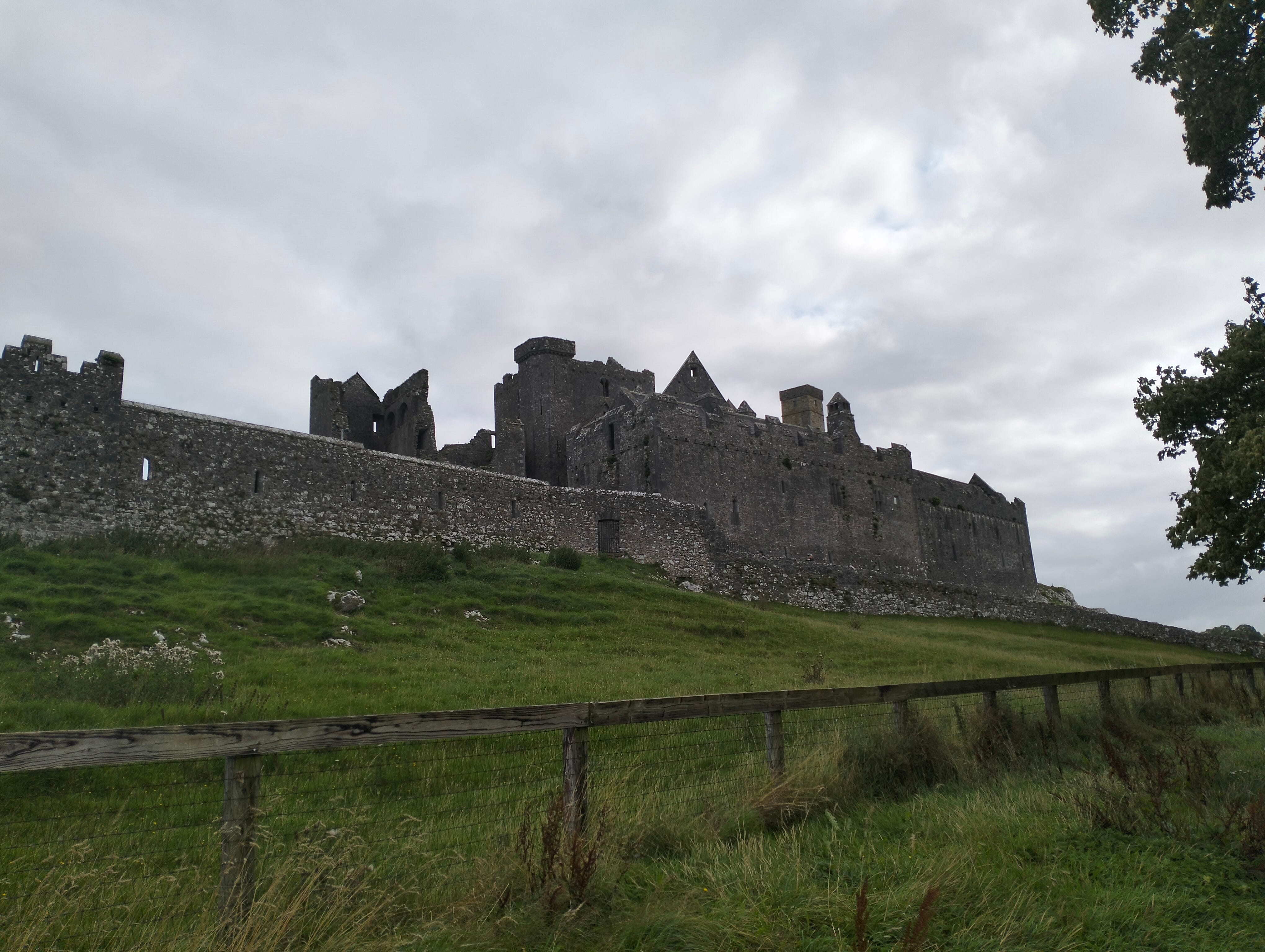
It’s at Cashel the next day that this part of the story all comes into sharp focus. It’s cold, and the wind is biting, and there’s a bit of drizzle, and frankly for all the drama of its looming appearance on the landscape, once we get there I can see why the holiest Christian site in Ireland might have been abandoned eventually. And that’s even without the grotesque massacre carried out by the Parliamentarians back in the War of the Three Kingdoms. (Part of which was the ‘English Civil War’ – but it actually involved multiple wars in Ireland and Scotland too). The Protestant leader of the massacre – the same guy who destroyed the Dominican priory we’d seen in Kilmallock - ironically converted to Catholicism some years later. Cashel is dramatic and has all the aforementioned architectural bits: cathedral open to the sky, round tower, royal chapel (which we couldn’t go in, because its murals are apparently too fragile to cope with lots of tourists’ breath), a bishop’s tall defensive castle to keep him safe, as a wealthy landowner in uncertain times; and a bunch of buildings around it too. Here’s the story, too, of the only ever English Pope, Adrian IV, basically giving the English king Henry II the right to be ‘Lord of Ireland’ so that the Catholics could gain a solid foothold against local Celtic Christian autonomy. Irish history seems to be of repeated betrayal by foreigners looking to grasp the territory.
But it’s also full of gnarly independent rural folk ignoring the rules. That’s perhaps what keeps being refreshing to learn about as we travel round this island, and has clearly been seductive over the centuries to those who’ve come in on behalf of some ruler or other. Sure, there’s Brian Boru, who pops up all over the place as the one actually Irish High King exception that proves the rule – the one big fighter against Vikings and their mixed Norse-Gaelic descendants (around Dublin, their capital), after whose death Irish politics became patchwork again, as they would continue to be, and as the fractured architecture we’re seeing keeps suggesting. On the way down from the Rock there’s a young guy playing brilliant fiddle; and further down still there’s a young harpist, who is playing lovely melodies herself. Both very Irish, you can hear it. Both very different. We head for a cup of tea and scone, to get out of the wind for a while.
This is County Tipperary: and now there are Tipperary flags everywhere. For it turns out that their men’s team just won the other great Croke Park match, the All-Ireland hurling final. I watch a replay with my Irish friend a week later: it’s classic end-to-end stuff, with goals and posts like in Gaelic football, but this time being a kind of variation on hockey, that looks a bit like a psychedelic egg-and-spoon race. Needless to say they wear helmets because those balls and sticks look pretty deadly: it’s kind of high-speed Quidditch. And once again, all amateur, and only played round here. (Though when looking up the results, I come across an article saying that hurling is taking off in Brittany, who are keen for “rediscovering” Celtic sports, even ones like this that only got formalised in the 1880s!) I’ll see some live hurling on TV while waiting for the ferry back from Inishmore: except it’s actually camogie, because for some reason the women’s version of the same game has a different name. Go figure.
We’re staying on a dairy cattle farm in the middle of Tipperary, and I help the farmer with milking when we get back from our day’s outing. A black and white cat called, er, Covid is hanging around waiting for some of that white gold. Our host reveals that if we’d stayed one night longer, we could have gone to the local weekly music session with him; it sounds like a craic at which we would have been welcomed despite not being experts in local styles. But the lively sounds from the musicians on the Rock are still ringing; I’m happy to wait a while more before I try and play any such styles of music myself.