Final Threads
Expedition to Atlantica #15: Irish Endings, Northern Echoes

And so at last my explorations come to a close. The whole Expedition to Atlantica series is available here. You can find fifteen pieces in all, beginning with my trip round Spain, a brief interlude in Portugal, moving on via northern Spain to France, crossing La Manche to England, and thence to Ireland where this piece continues. Most of these pieces are now available on the podcast too. And more writing is bubbling up, covering other lands and other topics.
The sand is grey, an ancient kind of grey; but it’s soft and the waves are welcoming. The sun even pops out from time to time. We’re on a beach north of Sligo, facing out into a delightful bay, and, as it’s mid-August, we’re not the only people making an afternoon of it. Once upon a time William Butler Yeats hung out here pretty often, the part of the world his mother came from, and there was a startling mural of him as my bus came into town. In the distance we can see Ben Bulbin, the local version of Table Mountain (though rather lower, as is often the case with these gentle Irish peaks); green and splendid enough for Yeats to write a well-known verse or two about it. Though mostly I know him for prophetic slouching beasts, foreseeing the rise of so many things about a crumbling society that we are familiar with today, and of course gifting us the title of an African literary work I’ve read and taught: Chinua Achebe’s ‘Things Fall Apart’. Down in South Africa, former President Thabo Mbeki is often derided for quoting Yeats over his pipe and while remembering his Sussex university days; ‘overly intellectual.’ But Yeats’s poetry was inspiring to a range of nationalist leaders, because Ireland was the first twentieth century place to rise up against the colonial invader and receive a qualified kind of freedom. Even if he himself was from the old elite, the kind of Protestants that once went to the cathedral my father and I had visited in Lismore.
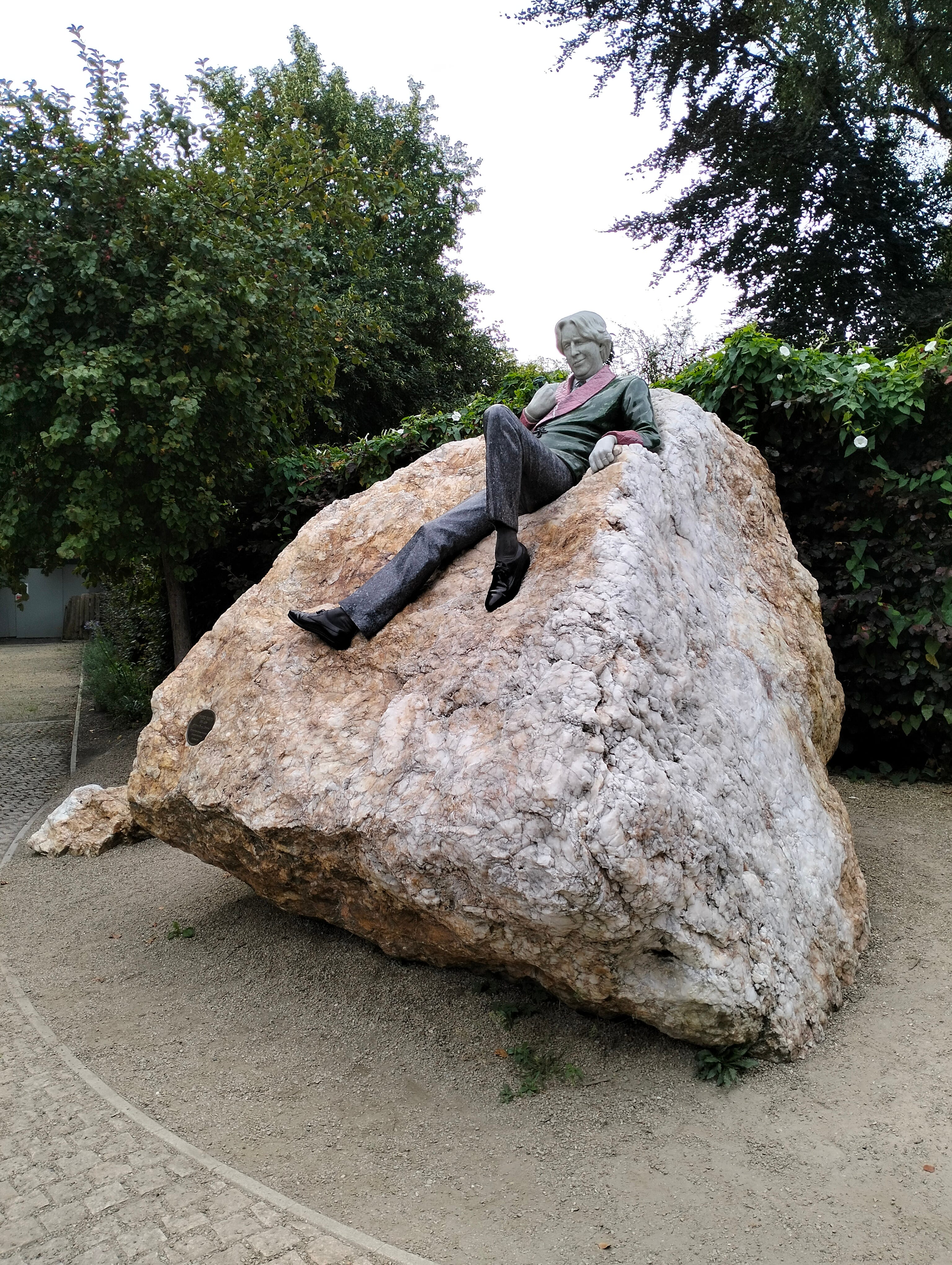
Ireland’s literary tradition is something I’ve touched on here, though personally I’ve mostly read novels and poetry by more recent Irish writers. In my time I’ve read and written about the classic Irish playwrights though: not so much Yeats, as Synge, Shaw, Wilde, Beckett. Like Beckett, Wilde died in Paris, but the best monument to him is in Dublin, his statue lazing nonchalantly on an uncarved rock, the humour in his inexhaustive list of sayings shared on nearby pillars. Before I get to Dublin, however, I have the opportunity to relax, partly thanks to meeting up with another South African friend, Jen, who’s currently living and working here in her parents’ birth country. I’ve been on the road for nine weeks, and had begun to feel pangs of homesickness. The perfect antidote is that my last few days in Ireland have been first with Norman and Jenny (who lived close to me for years in Muizenberg and Kalk Bay); and now with Jen (with whom I’ve taken cold water sea plunges often around the Cape peninsula), in other words with people I can have normal South African conversations with.
It also happens to be my birthday which is a great reason for the sun to be out, and for a little nature and water. We follow it up at Lough Key, inland at County Roscommon. There’s a few oddities in the grounds surrounding the lough: the Big House here burnt down in 1957 for the last time, and what’s replaced it is an inaccessible 1970s concrete ‘viewing tower’, standing eerily on the house’s foundations. Below you can see large tunnels leading under the surrounding lawns to who knows where. Some say portals, apparently. Not the first or last ones I’ll see, and an essential part of Irish lore. We also enter a grove where there’s a fir that is more than a mother tree – it seems that the whole tree’s base is sunk into the earth, and the entire grove is just one tree. Once this part of the country would have been almost entirely forest; not the case any more but there’s still lots of tree folk. Across the lough is an island with a castle on it. The original was built in the 13th century castle-building craze; the latest version in the 19th-century folly-building craze. I wonder aloud whether the British folly fashion – for pointless ‘ruins’ specially built in the grounds of country estates – was inspired by the existence of actual ruins all over the place on Irish estates. This one seems a little stuck, as the recent planned renovations ran into a lack of finance. We’re not stuck though: we refresh ourselves in the lake, and then retire, several times, to a wonderful mobile sauna on the bank, which we’ve booked for. These have sprung up apparently in the last couple of years, exactly as has happened around Cape Town’s beaches. A sudden global flourish of a great idea, it seems. The sauna is seriously hot, which is balanced by the seriously cold waters. Two local girls come in and share gossip about somebody’s messed-up wedding makeup. (Irish women seem to have a thing about wearing a lot of paint, according to another recent South African immigrant friend. A bus-stop advert I see in Dublin for something school-related seems to feature schoolgirls with excessive lashings of the stuff). We drive off into the Irish midlands, where there are names like ‘Kilbryan’ and ‘Knockvicar’, that really make you snigger at the anglicising of place names. And we collect fresh spring water. It’s easy to do, if you’ve got your ear to the ground and know what the locals get up to on the hillsides. Fresh, cool, clear. Ready to head for home, for a perhaps rare starry night (we see shooting stars and eat blackberries, and hear the sheep bleating. Jen’s landlord recalls the night a star shot a little too close, and he saw the meteorite explode in his field while dealing with a sick animal).
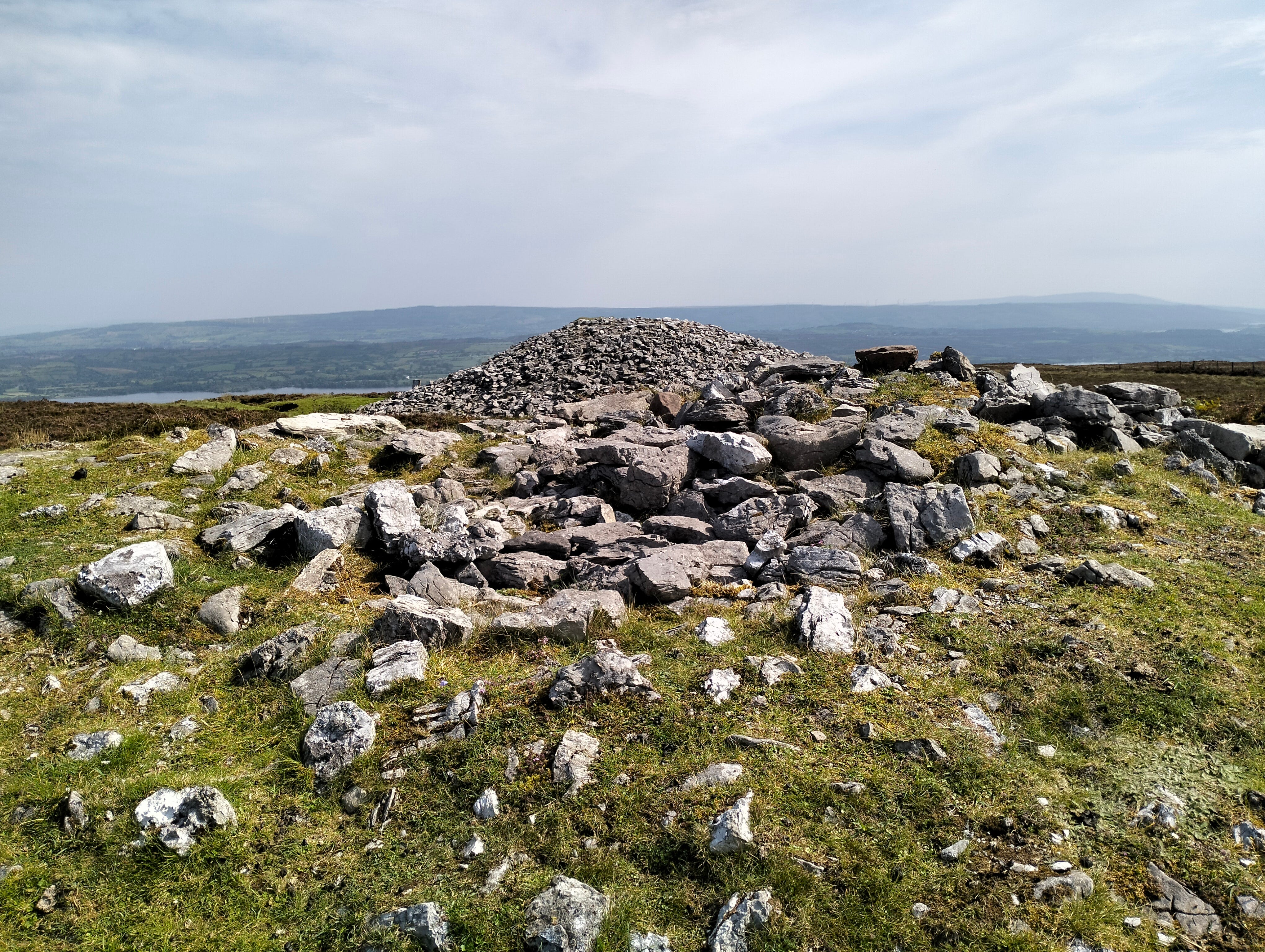
Above another lough, Lough Arrow, there are hills I go walking in alone the next day. (Something seems to have insisted that this be the nature of my journey, as I’ve had several travelling companions this time that can’t walk too strenuously for health reasons; and Jen has just found herself in the same predicament!) I walk up over distinctly peaty grassland, sometimes shearing away to reveal thick layers of the stuff. At the top are more ancient ‘passage tombs,’ the Carrowkeel Cairns. These are made with a mix of small dry-stone construction, and larger, impressive lintels and pillars; on top of various peaks, gently hemispherical; all seeming to speak to each other; probably having some kind of solar or stellar alignment, I would hazard. These are most definitely portals to something. There are signs requesting that I don’t enter, which I think about. I reflect that I’m coming with curiosity and reverence, which is what these places want from us, and not to damage or desecrate. The builders must have been acknowledging in some way the energies of the place. And the stories that come with them. Queen Mabd’s hill is nearby. We’re in fairy territory. I clamber on top of one, and am circled pretty swiftly by bees. These guardians appear and swarm around me on another ‘tomb’ as well, and I get the impression that yes indeed there may be areas I can enter and others I can’t. But the denial is from the guardians of the land. And that actually, they do allow me to carefully experience a number of the cairns. Where I find myself aware of the dark, the cool, and the light outside. They feel like nothing more familiar than a sweat lodge. So I have to sing, and pray, and even if I don’t know the ancient calls and runes and tunes of whichever people built this place, I feel I’ve made some acknowledgement of what this beautiful part of the world is giving me. As I walk down the hill, tourists from France arrive. Carnac, that Breton paleolithic marvel I read about, isn’t so far away from here; but they’ve come to explore mysteries of western Ireland instead. Before they could reach me, I was once again granted a little sacred time alone, to be a little weird. A raven lifts from the bush nearby and soars into the sky. The ash trees on the slopes rustle.
We drive on, to another Sligo beach, on the southern side of the bay we saw yesterday. There is bladderwrack seaweed in abundance, a memory of northern beaches in my childhood. No surf on this coast today, though that does happen under other conditions. Here at Dunmoran there are also weird little sand mosquitoes that make for quite an itch, though not like the horsefly that got me in county Tipperary: I wasn’t quite expecting the summer bugs in Ireland, but I guess it’s inevitable with the dampness and the slightly raised temperatures. It all gets soothed marvellously, however, when we’ve driven on to Enniscrone, where there’s an Edwardian seaweed bath experience we’re going to indulge in. Hot seawater, and freshly harvested seaweed, alternating with one of those wooden Turkish-style individual steamers, and a quick cold shower. It all comes out of old brass taps, and it’s strange to think that back in Yeats’s day, this was all the latest style, as modern as the upmarket gated-community-minus-the-gate I’d stayed at with my father outside of Cork. Now it’s quaint and a reminder of slower times, when the only ice cream option was vanilla, perhaps not even with the flake we add today. We drive back past numerous old houses in need of renovation: the government has apparently offered nice grants to those wanting to do up the old places, as part of the move to get the newly-growing population back to the land. However, we also see a number of pairs of donkeys, which I hear is a bit of a ruse: two donkeys are apparently enough livestock to claim you’re running a farm, which helps with other kinds of grant, in this part of the European Union system.
Jen lives just outside Carrick-on-Shannon, which as you might guess is another watery place. Quite an upmarket one, with many bays for privately owned river boats, many of which are out plying the waterways into the hinterland. Though it’s the county town for county Leitrim, Ireland’s poorest apparently – the land notorious for poor drainage, and thus not great for farmers; even the sheep often get foot-rot in the boggy winter. So Carrick is doing a mini-Dublin, being the centre for numerous regional service companies that don’t need a specific kind of geography, but for people that want a bit more peace than the big city, and perhaps got a taste of it in lockdown. Up the road is Leitrim village, and beyond it there’s a walk Jen drops me off for, while she does some admin at her co-working spot. It goes down one of the canals, and I amble along for a final look at rural Ireland. Several kilometres later, and past a few locks, and one or two characters piloting little boats, I’ve arrived at a big lakeland area with a lot of swans and lily pads. And a raspberry bakewell tart type of thing. I walk back on the other bank, take my shoes off to pad along the grass, enjoy the tall pink flowers that are everywhere. Take a last breath. Jen takes me to a pretty waterfall for a last look. The sun is still, remarkably, shining, and it’s even a teeny bit warm today. As it will be still when I get to Dublin.
Ronan, my final South African-Irish guide will greet me at the station and take me on a walk to his place, via a few views of the capital. My abiding memory of Dublin back in the ’90s is how monocultural and monoracial it was, for all the fun I had. That’s no longer the case; there’s been big shifts, perhaps a bit too fast given the creaking I see, and much of it in a materialist direction. As I write this, I’ve just met a Brazilian who lives in Ireland (and speaks English with a brogue), who’s currently in Cape Town: there are apparently 70 000 Brazilians there today, not as many as Portugal but enough to be a noticeable part of Dublin’s new diversity. Near Ronan’s house, which is itself close to fine Georgian terraces, we hear US accents, men in suits who probably work for Google or Apple or another of the global tech firms that are infamously taking advantage of Ireland’s lax tax system. I think of this when reading the novel I picked up in Paris: based partly around the true moment in the early 1970s when French scientists invented the internet, and the French president stopped them developing it, because of a self-interested French lobbyist. And US scientists spent more than a decade working with the clues before coming up with a system that has dark-internet holes, but that was enough to make our current tech world and a new layer of US cultural domination.
There’s a little girl playing the Irish harp on the street near her doting parents. Ronan says that on other days, there will be crack addicts nearby. Some recently broke in to his upmarket complex; the government has recently cleared a street-full of homeless tents from the neighbourhood, which sounds familiarly South African. And in his local park, a man is taking his pet rabbit for a walk. We cross Trinity College, and a cricket pitch; Trinity’s library hosts not just the Book of Kells, and every book published in the Republic; but, anachronistically, is also entitled to a copy of everything published in the United Kingdom, which is of course a foreign country. There are definitely a few oddities about Dublin I didn’t notice last time I was here in the nineties.
I’m really on a flying visit this time but it does include taking the trombone out to a session. There’s a great one happening a few minutes walk from Ronan’s flat; I listen carefully to begin with before gently adding some low tones. Of course, the trombone is not exactly a classic part of Irish traditional music, but the people are relaxed and the evening is a wonderful way to connect. There’s Paddy from Belfast, who plays a mean pipe. There’s Derek, an old crooner who’s well-known round here and has plenty of albums and concerts behind him. He sings Finnegan’s Wake, the original tune not the rather bonkers Joyce novel. His son sings a wonderful new song he’s written about breaking down walls. That’s I guess what music does. A Polish tourist comes and takes a photo of me which is very sweet, though I have to explain that I’m as much of a visitor as he is. There’s Guinness arriving far too swiftly on the table, though unlike the last time I was here thirty years ago, I’m able to resist enough to walk safely home afterwards. There’s a young lad playing the bodhran drum, and there’s a woman strumming the banjo, and there’s a keyboard and there’s lots of jokes for the crowd. One lady who gets up to sing is introduced as Anna ‘Montana’. There’s also authentic tobacco smoke, from numerous rollies, for the session is technically outside (there’s a crack in the roof that shows the sky). I hate to admit it makes the thing a bit more authentic for me, even though I’m not a smoker. It’s just getting dark; time to slip away from the music, which I suspect will go a few hours longer still, feeling uplifted and ready to leave. It’s been a great trip to this very foreign, and very connected place. Dublin faces east, and is on the same latitude as Manchester, to which I’ll fly the next day.
Where I’m greeted with far greater gentleness than when I left the UK. The airport seems pretty easy going, and the train station is too, with ladies that call me ‘love’ and ‘duck’. I haven’t been to the north of England in a quarter of a century, and I’ve never been to Huddersfield. This is a small, final leg of the trip, mostly to catch up with friends again. A lawn, on the edge of a little patch of hilly, typical Yorkshire moorland; a little toddler delighting in being creative with packing boxes, for my friend Dan has only moved in here recently. He’s doing a fair bit of work playing gigs for the rugby league. That’s the northern version of rugby, the one that was originally a professional, working class breakaway from amateur, upper class rugby union. Union might well have won internationally, but he shares that locals who are league fans have no interest at all in union. Possibly, league is a better game, though I’m not going to shout that too loudly in Paarl or Boksburg. We drive out to meet other old friends in the ‘posh’ bit of Yorkshire: Harrogate. It looks and feels a little more like the Clifton bit of Bristol, or even Hampstead, than anything more gritty. It is, however, made with stylish local stone, a different colour again to anything down south. The aubergine pasta thing I have is by no means an average pasta dish, it’s delicious and distinctly stylish, and, although our friends insist there’s an even pricier place they’d looked at first, it’s definitely not cheap. Dan and I had both thought, “Italian”, and were thinking of a decent-ish pizza, but clearly Harrogate is a bit of a different kind of location. Our friends are actually taking part in a music education course that’s being hosted at the local ladies’ college, so it is definitely possible to have airs and graces and be from the north: industrialists swallowed raw materials from South Africa and other parts of the imperial system, built factories that chewed up the local workers, but lived in a little more style themselves, and their legacy lives on.
Once upon a time (before I moved to Cape Town) I had considered living in The North of England. The service is not necessarily with a smile but it’s definitely warm, like I had in Ireland and will get again on my return to South Africa. I eat a fabulously varied Lebanese meal with another friend in Huddersfield centre, where I get a sense of that famous northern ‘local pride’. The shop buildings aren’t the most elegant but they’re solid, though my friend thinks there are probably some fronts for some kind of nefarious activity, as he’s apparently never seen people actually going in some of them. There’s a statue of Harold Wilson, and in Sheffield later there’s a big mural tribute to Barbara Castle, both old-school Labour politicians, which seems to me a little bit like resting on past glories. On the train, I see large solar arrays filling fields, a little different to the mountain-top electricity-generating windmills I’ve seen here and in Ireland, controversially peppering the terrain. But the sun is out so we can probably forgive everything with slightly rose-tinted spectacles.
In Leeds, my friend Chris takes me on the double-decker, past the main drag for drunken students, which the city has an enormous number of, and a lot of successful pubs it seems to meet them. We see a couple of people in odd fancy dress for late on a Friday afternoon, clearly getting ready for the alcoholic marathon. Instead, we venture out walking into some delightful woods and a gorge, breathing in plenty of natural beauty. This is the Headingley part of town, close to yet another cricket pitch (one where Ian Botham whacked the Aussies, a nine-year-old part of myself recalls); it’s probably one of the smarter parts of Leeds, though what I see of the city in general seems fairly bustling on this summer weekend. Even during the university break. Chris has roses in his garden, blooming and with a precious smell. It takes me back, not to the Wars of the Roses (an unfortunate late-medieval thing between Yorkshire aristocrats and Lancashire ones), but even earlier; to those delicate blooming gardens of formerly Islamic Spain, a long way south of here, near the beginning of my trip. That’s almost as far, as the crow flies, as from Cape Town up to the north of South Africa, to the north of the Kruger National Park. In both places there’s a lot of culture in between; and a lot of stories rising up from the land. Here we are, in an England where Islam is the fastest-growing religion, though paganism isn’t far behind and apparently Christianity is staging a bit of a comeback from a sleepy base. I don’t know what the next part of the story is: the peoples of Atlantica, and the peoples who’ve been ruled by them (like us in SA, but honestly, also like pretty much the whole world at one point or another), have to work that out together. We do it best when we see the links, the connections, and the love and beauty we can create together. And I think we are able to see better when we listen to the land. Time to keep walking. Even if this particular trip is drawing near its close, the journey continues.